Adopt a kitten, get some sweet corn!

Is anybody out there looking for a new pet? I know some kitties that need good homes!

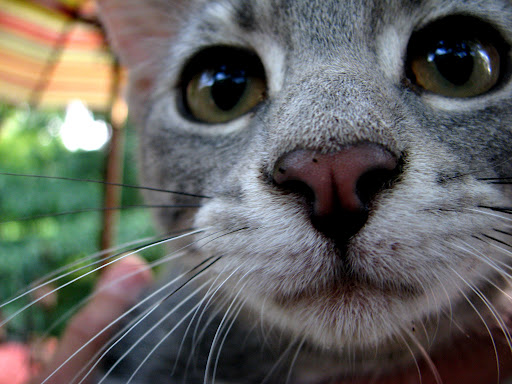
You know you want to take me home.

My aunt and uncle live on a farm near Hartville Ohio that is a magnet for stray cats. We adopted our Jasper kitty from my aunt two winters ago. The other strays decided they weren’t going to let him near the food she’d set out, or on the porch to keep warm. She’d run the dryer with nothing in it so that he could huddle under the vent outside. Needless to say, his life at our house is now much cushier, and he only has to put up with one 19 year old cat who is the definition of the word crotchety (her hatred of the new cat has given her extra pep, I swear. She was much less active before Jasper came, now she’s all full of energy to hiss and torment).  He is currently sprawled in the middle of my bed, taking up as much room as possible.

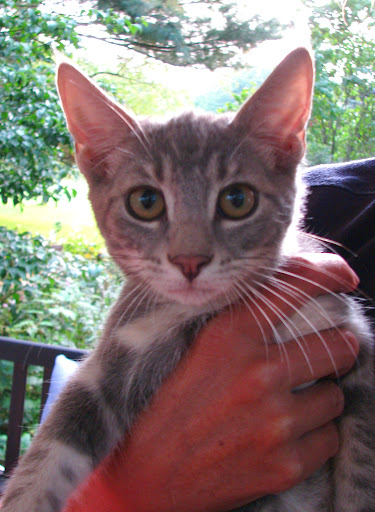
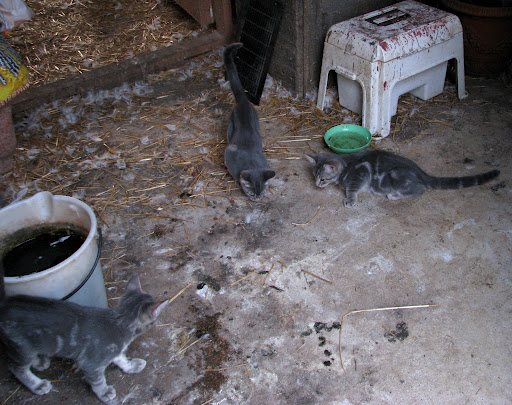
As my brother says, my uncle farms the vegetables and my aunt has a cat farm. There are lots of stray cats that have ended up at my aunt and uncle’s farm, and it would be wonderful if some of them could find homes before it gets cold out. In particular, she’s worried about these three gray cuties, all siblings, one boy and two girls, probably 4 or 5 months old. They were born in the duck barn and sleep there every night with the ducks (who are not exactly pleased with the arrangement).

Frolicking in the garden.
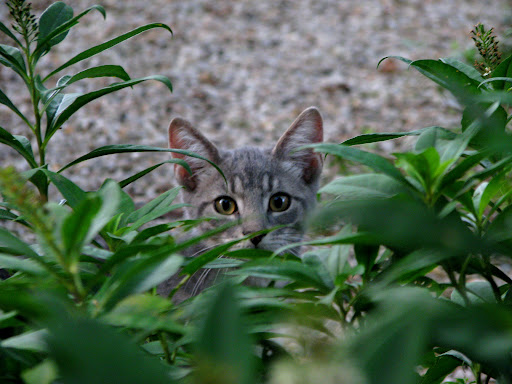
Hide and seek.

My aunt calls them her Peaweeds, and they come streaking across the yard to get put away every night. The ducks also come when she calls, but at a much more sedate waddle. The gray kitties are very playful, and my aunt can pick them up and cuddle with them. It’s pretty adorable.

Look into my eyes and take me home.
I spy a little gray kitty who needs a good home.
None of these cats have had their shots or been fixed, but you get a free dozen ears of sweet corn with each cat you take home! Well, that part may not be true, but I can certainly get you some produce I’m sure. I’ll even deliver the kittens to you, as long as you’re within reasonable driving distance from Ohio.
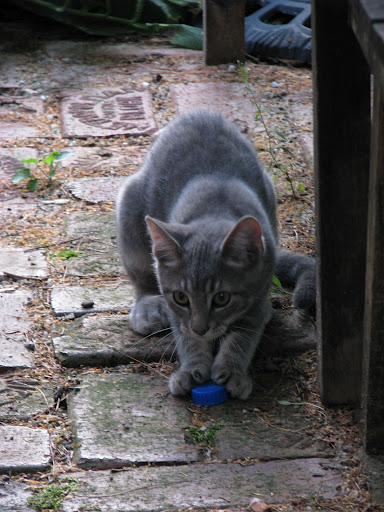
Not only are they cute, but also thrifty! A plastic bottle cap is just as good as any fancy toy from the pet store.
Treat time in the duck barn.
This callico is also very much looking to be a house cat, she tries to sneak into the house every chance she gets. However, with 6 cats already inside, my aunt has drawn the line at any more coming in. Not sure how old she is, perhaps a year or so.
I don’t know who you are, but I suppose I will allow you to take my photograph.
All cats, even strays, know how to sit like royalty.

If anyone out there is interested, let me know and I’ll hook you up with some extremely grateful kitties!

This Here’s A Goose

Brant. New York, 2011.

This here’s a goose, not at all like a moose
You can tell this by looking at its caboose.
A moose won’t have feathers; its behind is all hairy
A goose is more pointed back there, so be wary.
Mooses are also generally taller,
Gooses are therefore generally smaller.

Moose. Yellowstone, 2012.

If you get them confused, you should check your glasses,
And probably take a few animal classes!

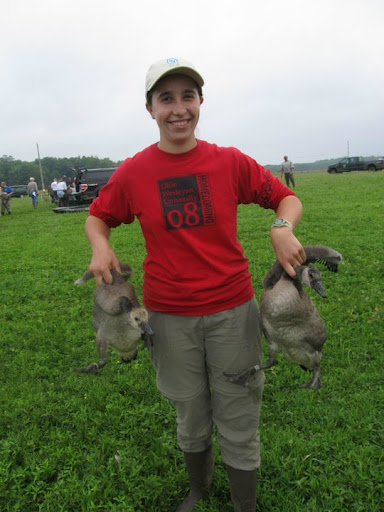
Young Canada Geese. Pennsylvania 2011.
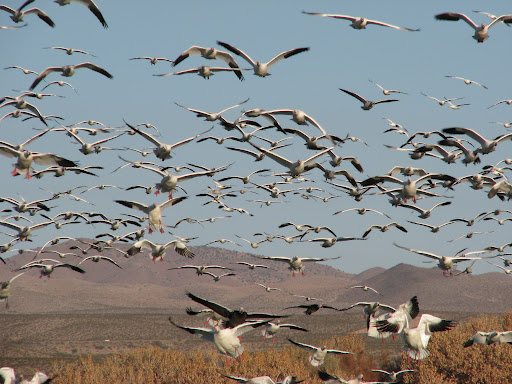
Snow Geese. New Mexico, 2011.

Jesus Takes 2nd Place at County Fair

Last Friday my family and I journeyed to the Medina County Fair. As usual, it was an interesting experience. The smells, the people watching, the food… brings back all sorts of childhood memories of being pulled in the wagon with my little sister, looking at the gigantic horses and pigs. The horses and pigs have gotten a little shorter (or maybe I’ve just gotten taller) but everything else is still the same.

After dinner of burbon chicken, rice and beans for my parents and I and a foot-long hotdog for my brother, we split up. Some of us had a strong desire to look at the tractors (because we only have two at home in the barn) and others of us didn’t.

Mom and I wandered over to the barn with the antique displays, where we found a wide variety of things, from beautiful china cups and toys that I played with when I was little, as well as lots of dishes that we’d seen at Goodwill. There were a lot of very nice antiques, don’t get me wrong, but not everything was maybe really that interesting.

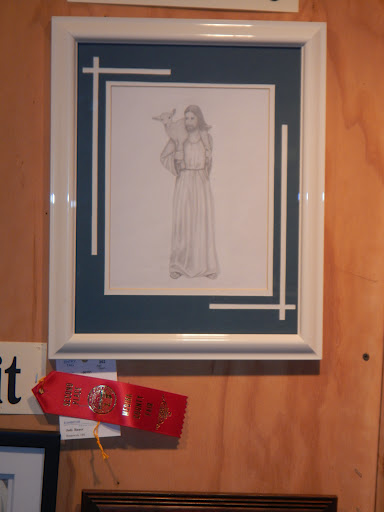
After the antiques, we made our way into the barn with the art. I like to think that, with as many artists in our family as we have, I have a fair idea of what constitutes “good” art. I realize that art is very subjective, but still. The painting of Jesus with various grenade-launchers and machine guns, made to look like a violent movie/video game cover, not good art. Also just plain bizarre. Most of the other art had more traditional subject matters, (like the one of Truffula trees made by an elementary-schooler) and was much more pleasurable to view.

Jesus took second place… 
To a Native American. How many times has that ever happened?

After the art, we went for the sweetest part: some local honey. They let you sample as many as you like, and it’s all fantastic. My favorite was the ginger-infused, which is why there is now a giant piece of ginger sitting out on the counter, waiting to be put in the 2lb jar of honey we bought.

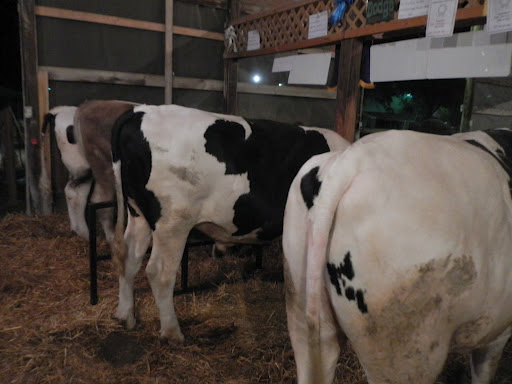
After honey, the animals. Wandering up and down the barns looking at cow, horse, goat, and pig butts is always a good time. Made me glad that when I did have farm chores at my one internship, they didn’t involve shoveling anything smelly. However, my main responsibility was working with elementary school children, so I’m not sure which is worse– 10 to 12 extremely energetic inter-city 3rd graders from Dayton who have never been in the woods before, or shoveling manure. There were maybe more than a few days when I would have gladly traded dealing with the kids for shoveling their weight in cow manure.

The line-up of cow butts.
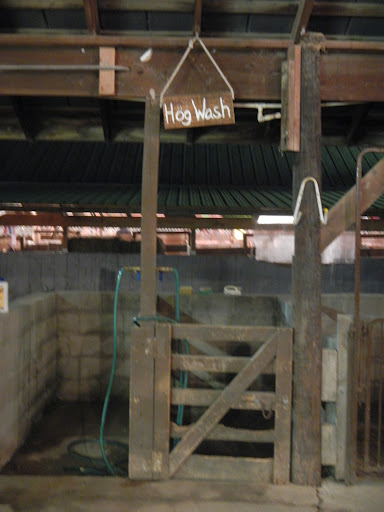
It’s all hog wash.
Food dishes make nice pillows apparently.

Finally, just before we left, the very best part of the fair– milkshakes from the 4H stand. I dream about these milkshakes sometimes. That might not strictly be true, but they are very delicious.

I haven’t been to the fair in quite a few summers, so it was fun to go back and experience again all that is the county fair.

The best milkshakes in the world. Or at least Medina county.

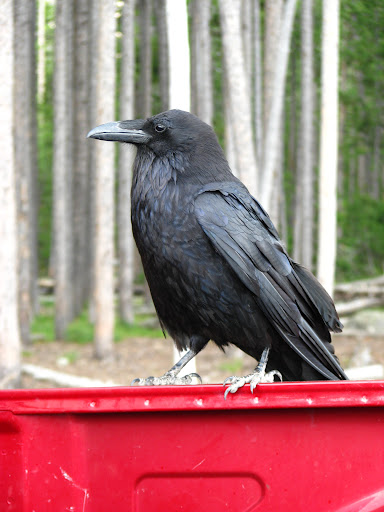
I am a Raven, I speak for the trash

I am a Raven, I speak for the trash–
The litter, the waste, it’s all better than cash.
What’s a bird going to do with a dollar bill?
But with trash, oh ho, I can eat my fill!
Tourists are best, with their picnic lunches,
There’s always scraps left for me to munches.
I’m not picky, I like both rye bread and wheat,
Just leave me your crusts on the ground, what a treat!
Scavenger by trade, I eat what I find
It’s been many a Dumpster in which I’ve dined.
Say what you like, but you know I don’t care–
With a bob and a flap I’ll take to the air.
I soar high and far, my eyes are keen
Spying trash pits and garbage, that’s dinner I’ve seen!

Merle’s Door: Lessons from a Freethinking Dog

I just got back from spending 13 days in the Yellowstone/Grand Teton area with my family. There will most likely be a series of blogs about this epic travel journey (and epic it was) once I go through all my pictures and videos, which may take days. I take a lot of pictures.

While you’re waiting breathlessly for my next post, read this book: Merle’s Door: Lessons from a Freethinking Dog, by Ted Kerasote. It’s quite good. Excellent, really. I picked it up at a Goodwill somewhere, liking the picture on the cover (Merle the dog on a mountain top) and I’m glad I did. I’d even consider paying full price for this one, which is saying a lot since I buy most of my books from Goodwill for $1 or less.

Bogie is particularly enthralled with the book.

However, I would not recommend reading the ending on a plane, especially not while sitting between a middle-aged man and a just-barely-post-adolescent man, both strangers. I cried. Twice. Well, I did manage to keep in the body-heaving sobs, but my eyes definitely teared up. If this book doesn’t at least give your heart a wrench, you probably don’t have a soul. I don’t normally cry when I read– in fact, I can’t really think of any other time reading when I was tempted to (not even when J.K. Rowling offed Dumbledore- but I think I was in shock)– so that says something about the poignancy of the subject and the writing.

The book is set out West, primarily in Kelly, Wyoming (in the shadows of the Tetons, where we were on vacation). Basically, the book is about Ted and his dog, Merle, and their lives together, starting when Ted finds Merle in the Utah desert and ending with Merle’s death (hence the plane sobbing). The book not only follows the relationship of Ted and Merle, but also delves into the relationships between people and dogs, where they originated, and how those relationships have evolved since then. Excellent writing, excellent subject, excellent book.

Our pets have it rough in the Smith household.

From the prologue:
“This is the story of one dog, my dog, Merle. It’s also the story of every dog who must live in an increasingly urbanized world, and how these dogs might lead happier lives if we changed some of our behavior rather than always trying to change theirs.
…[W]hat he taught me about living with a dog can be applied anywhere. His lessons weren’t so much about giving dogs physical doors to the outside world, although that’s important, but about providing ones that open onto the mental and emotional terrain that will develop a dog’s potential. His lessons weren’t about training, but about partnership. They were never about method; they were about attitude.And at the heart of this attitude is a person’s willingness to loosen a dog’s leash– in all aspects of its life– and, whenever practical, to take off its leash completely, allowing the dog to learn on its own, following its nose and running free.”

Ted Kerasote’s website, with information about this book and his others, including newer books about his dog after Merle:

Merle’s Door: Lessons from a Freethinking Dog, by Ted Kerasote.
c. 2007 by Harcourt, Inc.

How To Capture and Band a Mourning Dove

First you must bait the fields, which have been disked properly by an approved U.S. Fish and Wildlife employee. The area where the bait is placed must first be raked smooth, so the doves can see the bait and have a nice landing area to wander around in and leave footprints. You should probably not joke about leaving dirt angels (like a snow angel, but in dirt) when asked by your boss if you did raked and baited correctly. (What kind of question is that though, really?) Also you should probably not leave messages written in the dirt for said boss, though said boss never did see it.

Baiting the dove field.

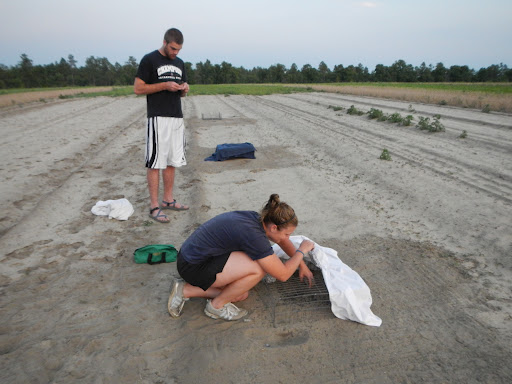
After you put out the bait (sunflower seed is what we used) place a metal trap over the bait pile. There is an art to putting out bait. It must be perfectly arranged under the trap or the mourning doves won’t come. They’ll just hang out around the outsides of the traps and not go inside and get caught.

Whitney with the seed bucket.

After an hour or so, go back and check the traps. If there are doves in them, cover the trap with a sheet to calm them down so they don’t hurt themselves against the wire before you get them out.

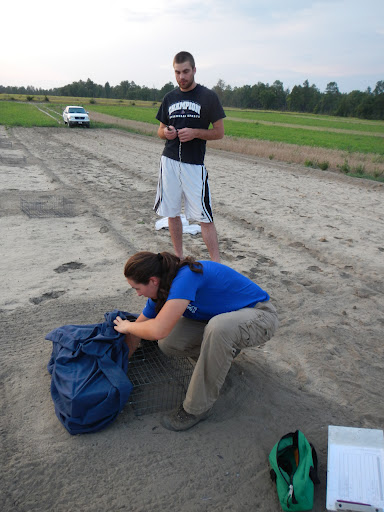
Whitney removing a dove from the trap while Brady busies himself with the bands.

If you’re really lucky you’ll catch more than one or two doves at a time. However, in my experience, you only catch multiple doves when a big storm is blowing in and the last place you want to be is crouched over a metal trap in the middle of a wide-open field as the lightning gets closer and closer. Then you’ll catch 20 at a time. Other days, maybe 5.

Lauren removing a dove from the trap. Brady stands in the back being exceptionally useful.

After removing the mourning dove from the trap, determine age, sex, and molt status. If any of the feathers on the body and wings have buffy tips, it is a young (hatch year) bird. If it is a hatch year, then the sex is unknown. If it is an adult, males have a slate colored patch on the crown and rosy-tinted feathers on their breast. Females are plain and boring looking. Molt is determined by looking at the wing feathers and seeing which one is growing in, and therefore is shorter and a slightly different color than the older feathers.

Whitney figuring out molt status.

Once you have all that information figured out, a numbered band from the USGS is placed around the right leg of the dove. We were given 100 dove-sized bands, so once 100 are caught we’re done. The banding is done to help gather information about the doves during the dove hunt.

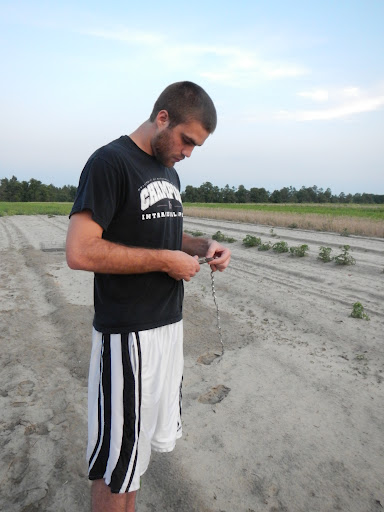
Brady preparing the bands.

Once the band is on, and the the information is written down, release the dove and start over!

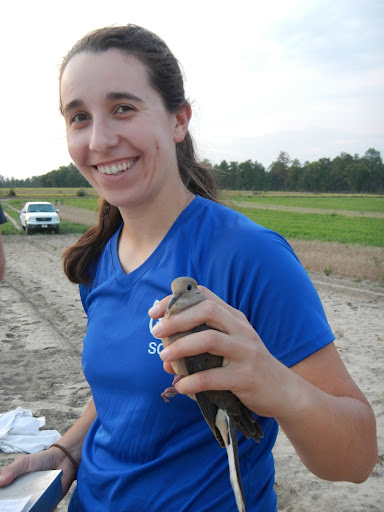
Lauren with a dove.
You can’t really tell, but this is an adult male mourning dove. Most of the adults we catch are males.  Nancy thinks this is because males are dumber than females. Might make an interesting study…

Una Sinfonia para Bananas

1. Banana Dance
When banana chips
Pass my lips
I do a little dance
Good and yummy
In my tummy
Around the room I prance
But when I’m done
There will be none
Sorry, you’ve missed your chance
I’ll take a beer instead


2.  Second Banana
You started in a tree
Free in the leaves and air
There, growing and living
Giving food to the spunky
Monkey, sating its thirst.
First the color of green
Seen in the leaves and grass
Class of your own, then
When you mellow,
Yellow. The typical color
Duller than the sun, but still.
Will you be split and ate,
Great with ice cream?
Dream of mashed and
Bland in bread. Or cut
But leave to dry
Try plain and sweet
Beat by none of the above
Love to eat, banana chips.

Put your hands in the air like you just don’t care


3.  Dream fruit
The aroma of
Musa acuminata
Pervades my senses
The fragrant flesh with its
White seedless pulp and
Amber gold skin.
Oh ye gods! Food for you all
In this delectable fruit!
Tongue and mouth in ecstasy
Over this ethereal essence.
The name, a sacred whisper
Banana

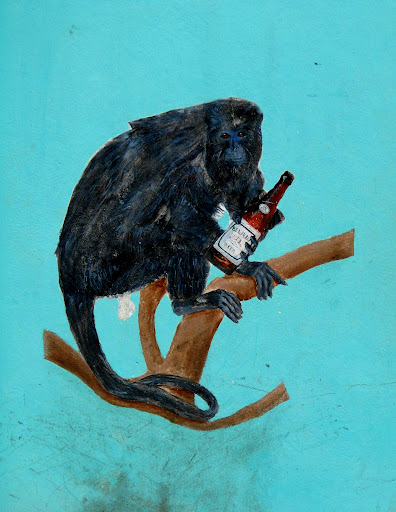
Look into my eyes and give me a banana


Animals on the Refuge

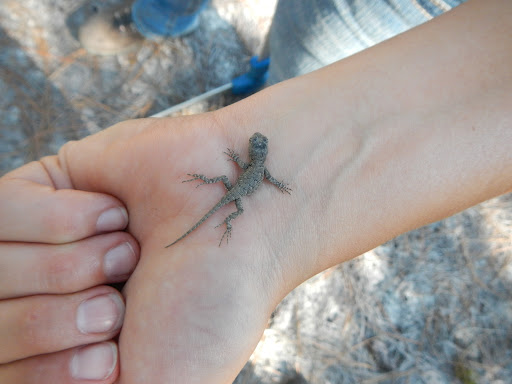
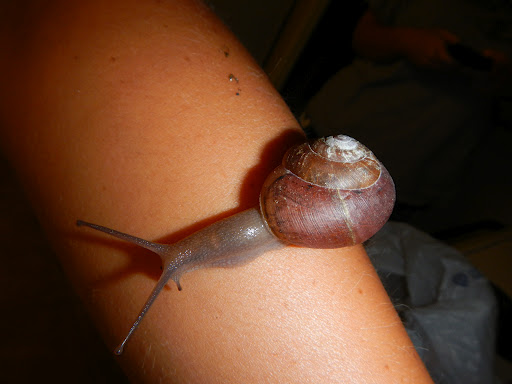
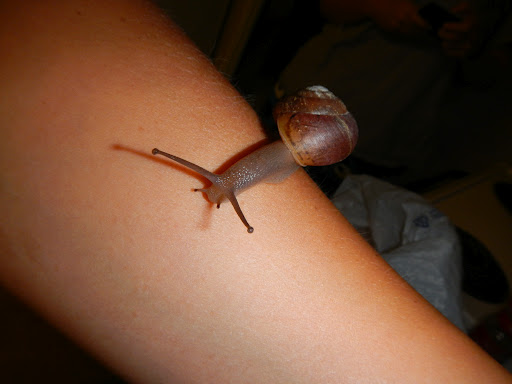
Though you might not realize it from reading my blog, there are in fact other animals at Carolina Sandhills in addition to red-cockaded woodpeckers. Here are a few pictures of some of them and fellow intern Whitney’s arms. There may be a full-body shot in there somewhere too.

We found a turtle! This is a male yellow-bellied slider. Male because it’s flat on the bottom (in fancy terms his plastron is slightly concave). The theory is that this helps the males to climb on top of the females when they breed.

I like the shadow of Whitney’s hands and the turtle on the ground.

We found a small tiny lizard that tried to climb Whitney’s pant leg during one of our vegetation surveys.  Our best guess is eastern fence lizard. Whatever it is, it’s cute.

Whitney found a land snail and brought it in the kitchen! She was outside the bunkhouse one evening making a phone call, and found this dude on the stoop. Actually, this snail might be a dudette, or both (many snails are hermaphrodites) so let’s just stick with “dude.”

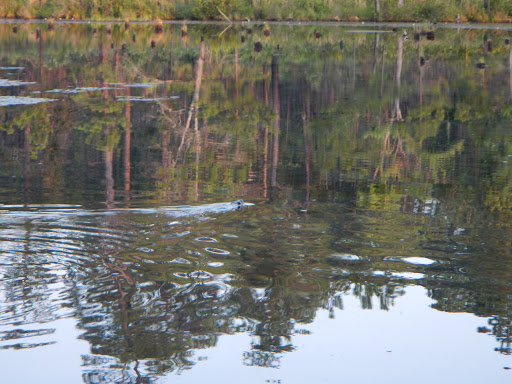
One afternoon as we were driving back to the office, we saw a dark shape lumbering down Wildlife Drive. We first thought it might be a raccoon, but as we got closer we realized it was a beaver. We stopped the truck a respectable distance away, got out, and took some pictures. Instead of staying away from us, the beaver strolled right up, crossed the road in front of the tuck, and trundled along just a few feet away from where Whitney was crouched taking pictures. It then crossed back over the road and headed into the pond.

Close encounters of the beaver kind.

The Beaver Song, which I learned from Chris at Aullwood Audubon Center and Farm. There are also hand motions, which I’d be more than happy to show you sometime. I only remember the chorus, which is a call and response.

Long tail (Long tail)
Big buck teeth (Big buck teeth)
Swimmin in the water (Swimmin in the water)
Chewing on trees (Chewing on trees)
Building up a dam (Building up a dam)
You know who I am (You know who I am)
I’m a Beaver, I’m a Beaver, I’m a Beaver! (I’m a Beaver. I’m a Beaver. I’m a Beaver!)

Swimming away, looking for trees to gnaw on.

Beavers can weigh up to 60lbs, and can be 23 to 39 inches long, excluding the tail, which adds an additional 8 to 12 inches. Not something you typically expect to see trucking down a paved road in the middle of the afternoon, especially as beavers are usually nocturnal.

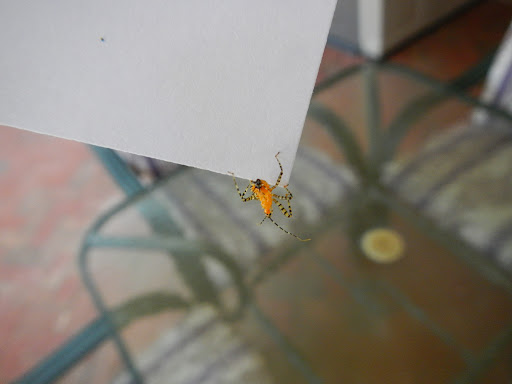
And these pictures don’t have Whitney in them (and therefore are not nearly as interesting) but I did find this really neat insect while I was cleaning my peeper– the telescoping camera we use to look in woodpecker cavities. Not sure what it is, but it’s cool!

The Last RCW Banding

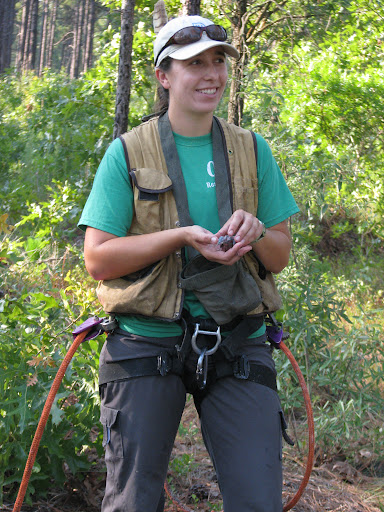
Friday was the last RCW banding of the 2012 season. It’s been a busy few months, and while it is nice to not be as busy (especially in this heat!) I am sad that there are no more trees to climb and ugly baby woodpeckers to play with. My time here at Carolina Sandhills is almost up, and it’s been fantastic. I am exceptionally glad I took this internship and was able to spend 12 weeks here working with RCW’s. Birds are always fun, and climbing trees is awesome, but I think the best part of this internship has been all the people I’ve been privileged to work with. While I’m not always excited about getting up early or having to tromp through the chigger/horse fly/ poison oak infested forest to look for cavity trees, every day is still fun because of the people here. I’m not sure where the future will take me after I leave this place, but I’ll never forget the experiences and people. Especially Brady Vaassen, fellow intern and one of my housemates, who is sitting here on the couch next to me asking when I’ll write a blog post about him and trying to get me to move so he can have the entire couch. Just because you’re 6ft 5in and a bit doesn’t mean you always get to hog the couch.

Pictures were taken by the fabulous Whitney Wallet, intern extraordinaire and friend of the first class.
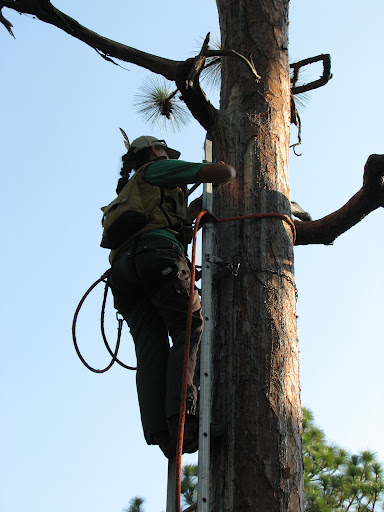
20ft up a longleaf pine at a RCW cavity. And yes, I do have a turkey feather stuck in my hair.
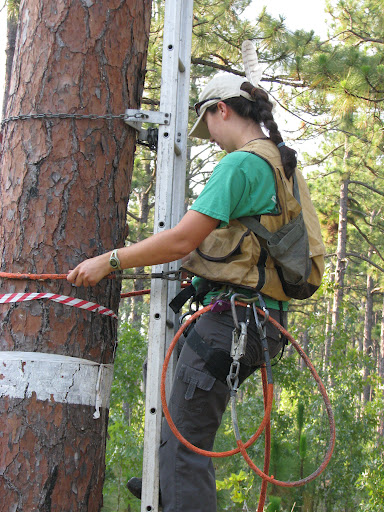
Trying to get the nestling out of the cavity with my noose.
Nestling secured in the bag slung around my back, and heading down to the ground to get it banded.
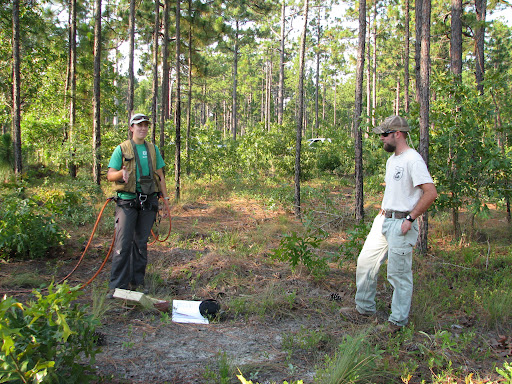
Getting ready to band (or standing around looking important).  That’s Evan Brashier on the right (not an intern, he actually gets paid), he banded the chick since I got to climb up and noose it.
Chick in hand, I make my stand, ready to band, best in the land.
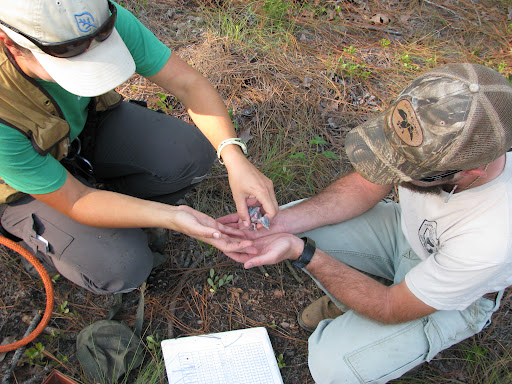
The passing of the RCW chick.
Evan banding the chick. It was about 9 or10 days old.
Climbing back up to put the newly-banded nestling back home.
I don’t normally get this excited about putting nestlings back, but there were some interesting comments coming from the peanut gallery on the ground (aka Whitney and Evan).

A Blue Jay Tale

by Lauren Smith
pictures by Meghan Oberkircher


Once upon a time there was a baby blue jay who, when he was very small, decided he wanted to become an adventurer and explore the world. Unfortunately he decided this before he could fly (and before he really had any feathers) so he didn’t get very far.


A hog-nosed bat named Batrick (Bat-Bat to his friends) flew by on his nightly foraging foray and, seeing the poor little blue jay shivering on the ground, decided to take it home to his bat cave.


The little jay, with little thought for his probably slightly worried parents, climbed on board Bat-Bat’s back for the journey to Bat-Bat’s bat cave.


Bat-Bat’s mother was not exactly pleased about another mouth to feed but she let Bat-Bat, her only son, keep his new foundling. Bat-Bat didn’t have too many friends, so his mom didn’t have the heart to deny him this new companion.


The year went on and the little jay grew into a grown-up normal-sized jay. The jay, who they did name (but as bats only communicate with high-pitched squeaks, no one but Bat-Bat and his mom knew what the jay’s name actually was) learned how to live like a bat. He roosted upside-down during the day with Bat-Bat and his mom, and ventured outside at night to eat copious amounts of insects.


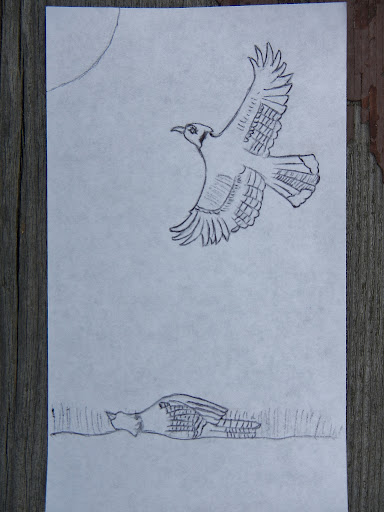
One night, while chasing a succulently juicy moth, the jay became so single-minded he forgot to watch for predators. The jay, since he didn’t know how to echolocate and didn’t have the greatest night vision, was usually pretty bad at catching enough food to eat. This night he was particularly hungry, so his owl-dar was down.


Owls and blue jays tend not to get along, and this encounter did not end well for our blue jay friend.


Lucky for him, the next morning an attractive female blue jay named Mary Jayne flew by while taking her morning constitutional. Mary Jayne was an exceptionally observant jay and it only took her 20 minutes to notice our poor jay friend laying on the ground, gasping for air.


Mary Jayne decided that she needed to nurse the poor wounded jay back to health.


Mary Jayne had never nursed anyone back to health before so she wasn’t really sure how it worked. She decided to take the wounded jay to an old red-cockaded woodpecker cavity in a longleaf pine tree so he could heal in privacy. Al of the sap adhering to his wounds helped them to heal quickly, though the jay pretended he was still weak so that Mary Jayne would continue to feed him mouth-to-mouth. 


Since they were on such intimate terms, they decided the jay needed a name. After much deliberation, they arrived at Elmer. Both agreed that Elmer was a fine, strong name for a blue jay. 


The newly christened Elmer Jay took Mary Jayne back to the bat cave to meet Bat-Bat and his mom. They, unlike Elmer’s jay parents, were actually worried when he disappeared and had spent many nights searching for him. 


Bat-Bat and his mom were overjoyed that Elmer had returned and was all in one piece. They were so happy to see Elmer and Mary Jayne that they broke into a spontaneous dance, which most bats reserve only for truly special occasions. 


Naturally, Elmer and Mary Jayne hooked up, and after a year or so started having little baby jays of their own. They were very good parents, and never let any of their offspring get stolen away by bats. 


Bat-Bat also eventually found a female friend and they too procreated, producing a cute little son named Batrick Jr. 


The Bats and Jays remained close and their children frequently had sleepovers. Even tough the Jays decided to go diurnal, they did decide that roosting upside-down was a much preferable sleeping method. 


Both the Bats and the Jays went on to live long, fulfilling lives, full of joy and happiness. 


The End


For an article on upside-down roosting blue jays, see: 
http://pispbirdbanding.blogspot.com/2011/09/new-study-shows-blue-jays-roost-upside.html