Boulder, Colorado

Welcome to Boulder, Colorado!

Boulder, Colorado is a mix of all sorts of things, but most of them have to do with being outside. This is a town where one can buy oxygen*, grass (wheatgrass or marijuana), and water at exorbitant prices, but can also be immersed in all three for free in any of the more than 40,000 acres of protected green space in and around the city.

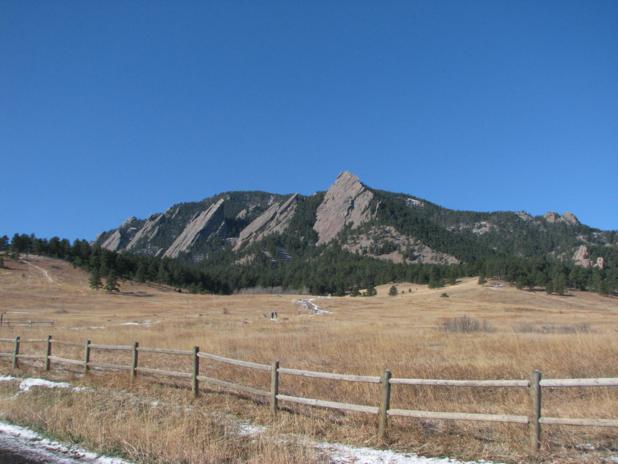
Perhaps the most iconic symbol of Boulder is the image of the Flatirons, rock formations located just west of town. Named by pioneer women who thought they looked like irons (not especially creative, but an apt description), they are conveniently located a few minutes from downtown. The Third Flatiron stands 1,400 feet tall, and was first climbed by Floyd and Earl Millard in 1906, the earliest recorded rock climb in Colorado. Since then it has been climbed thousands of times in a number of fashions, including by two men wearing roller skates, by only the light of the full moon, and naked.

The Flatirons

The Flatirons

Boulderites like to play hard. The city hosts a “robust biking culture,” and many take advantage of the roughly 300 miles of bike lanes and paths, which are used year-round. On an average day, city employees counted 3,574 bikes in the downtown area. About 15% of the city’s annual transportation budget goes towards bike programs, and about 10% of all work commutes are made by bike, almost 20 times the national average.

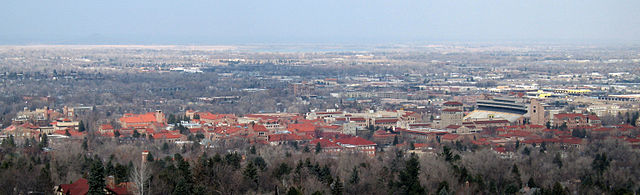
The first people to live in the Boulder area were Native Americans of the Arapahoe tribe. Then in 1859 came the white men and the Boulder City Town Company, who divvied up the land into parcels and sold them for $1,000 per lot, later lowered to attract more buyers. The Territory of Colorado itself wouldn’t be established for two more years. Prior to 1861 Boulder was part of the Territory of Nebraska, which probably has nothing to do with the University of Colorado Boulder Buffaloes / University of Nebraska Cornhuskers football rivalry. The University of Colorado has been up and running in Boulder since 1877, and today hosts about 30,000 students.

The University of Colorado Boulder campus

The University of Colorado Boulder campus

Without Pearl Harbor, Boulder might not have grown into the town it is today. During WWII, the US Navy located its Japanese school at UC Boulder, which brought people from all over the country to the area. After the war, many of them came back, increasing the population by about 10,000. The 300 days of sun a year probably had something to do with it. Today, the population is just under 100,000.

According to a mile-high list of publications, Boulder is an ideal place to live if you are: a woman executive, innovative, a biker, happy, a foodie, well-read, an in-shape baby-boomer, educated, brainy, raising an outdoor kid, an artist, someone who works for a technology start-up, part of a LGBT family, or someone who likes trees, among other things. Says one local, “I love Boulder, sure there are a lot of people who are weird as shit (last night I had a 50 something hippy tell me she could teach me yoga while having sex with my girlfriend) but that’s half the fun of living here.”

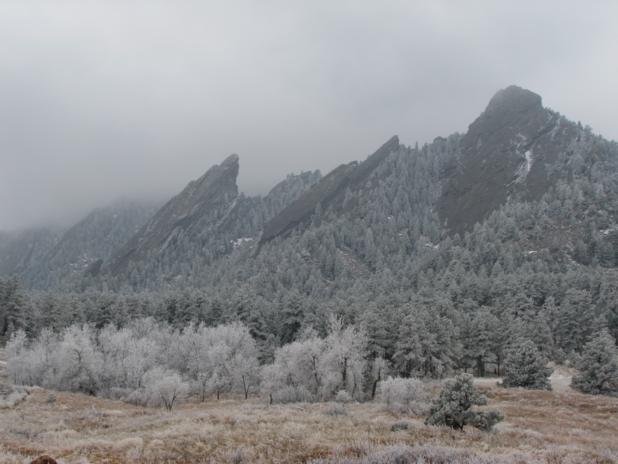
Frosty Flatirons

Frosty Flatirons

References:

10 Things You Didn’t Know About The Third Flatiron. By Amanda Fox, Climbing Magazine. http://www.climbing.com/climber/10-things-you-didnt-know-about-the-third-flatiron

The Best Bike Cities in North America: Boulder, Colorado. By Sarah Ripplinger, Outside Magazine. http://www.outsideonline.com/adventure-travel/north-america/The-Best-Bike-Cities-in-North-America-Boulder-Colorado.html

The Best Cities to Raise an Outdoor Kid: The Winning 25. By Jason Stevenson, Backpacker Magazine. http://www.backpacker.com/august_09_the_best_cities_to_raise_an_outdoor_kid/articles/13125

Boulder, Colorado: The City Everyone Loves to Love/Hate. By Ryan Krogh, Outside Magazine: http://www.outsideonline.com/adventure-travel/best-towns/Boulder-Colorado.html

Boulder, Colorado USA (Boulder Conventions & Visitors Bureau): http://www.bouldercoloradousa.com/

*Boulder’s Tonic Oxygen Bar goes ‘herban.’ By Alicia Wallace, The Daily Camera. http://www.dailycamera.com/boulder-business/ci_13248260

City of Boulder, Colorado Homepage: http://www.bouldercolorado.gov/

The Gore-Tex Vortex. By Marc Peruzzi, Outside Magazine.  http://www.outsideonline.com/adventure-travel/north-america/united-states/colorado/boulder/The-Gore-Tex-Vortex.html

Mountain Project Boulder page, submitted by John McNamee: http://www.mountainproject.com/v/boulder/105801420

Oxygen bar’s clients are encouraged to inhale. By Barbara Hey, Denver Post. http://extras.denverpost.com/life/oxygenbar0328.htm

Wikipedia: Boulder, Colorado. http://en.wikipedia.org/wiki/Boulder,_Colorado

Wikipedia: Colorado-Nebraska football rivalry. http://en.wikipedia.org/wiki/Colorado%E2%80%93Nebraska_football_rivalry

Picture Attributes: 

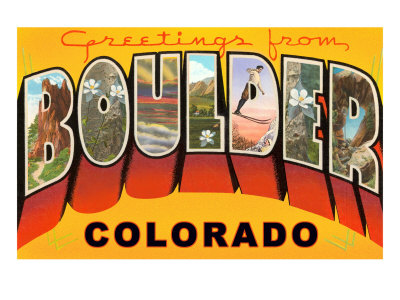
Boulder postcard: http://www.yoganonymous.com/

CU Boulder campus: http://en.wikipedia.org/wiki/File:CU_boulder_campus.jpg

Flatirons images courtesy of the author

Utah Wandering


Utah road


I’ve lived a lot of places, but I’ve never lived out here, in the desert of Utah. I wonder what it would be like, to wake every day to this. It looks like simple starkness in all direction, but looks can be deceiving. We drove past a man walking down the highway–on the wrong side of the road I might add, he should be walking against traffic. Not that it matters, with so few cars. We’ve only passed maybe 10 so far this morning, including all those in town where we stopped for gas, coffee, and the bathroom. I forgot to brush my teeth. The man was miles from the nearest building, at least a 30 minute drive from our direction, 5 miles in the other according to the sign he passed. It’s just after 8 a.m. Where is he going, and where did he come from?

This is a long road to walk to get to nowhere in particular, and probably even longer to get to somewhere specific.

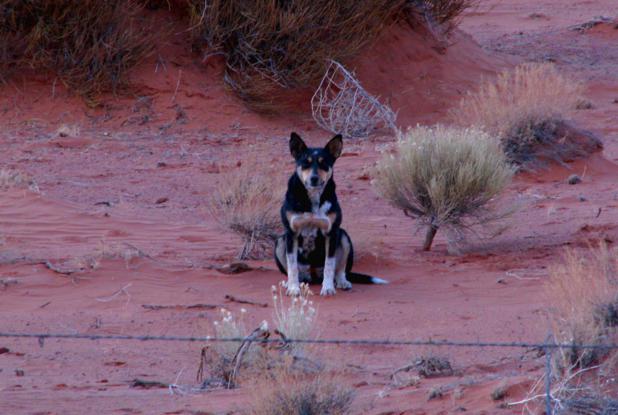
dog in Utah

Corrugated Hummingbirds

I’m almost wary to draw my hand away, as if, without me to hold it, the heft of the skies, heavy with stars and longings, would fall.

Belize

Written during my trip to Belize, July 2010. All pictures are from that trip. 

There is something about water, the sound of water, that is relaxing, almost numbing, but refreshing as well. The cleansing sound of water, reaching those places inside that even the sun cannot see.

I’m sitting on a raised deck on a tiny island off the coast of Belize, in the wind, in the dark. The surf and the wind in the palms behind me blend together into a wild, reckless sound that fills my soul with a deep longing, a restlessness of the spirit. I have a moment of profound loneliness, a deep ache echoed in the night sky.

The deck shakes a little, and the railing over the water is loose and shifting in the wind, causing vibrations that feel like footsteps, the footsteps of someone who isn’t coming. I can see out in the dark to the reef, to a light way out over the water, perhaps another caye. Behind me are palms dancing, and a bit of corrugated iron roofing that somehow manages to hold on to the deck bangs strenuously. The nails must be strong, tenacious, to defeat the continuous, mildly violent, wind.

Belize cayes

I could close my eyes and be a thousand miles from here, on the Florida panhandle, about to bed down for the night behind an abandoned motel, listening to the wind. That wind was more primeval and had more force, violence, to it. I could feel myself almost being blown away, swept off across the Gulf, like a ruby-throated hummingbird. This wind is not as strong, but there is still a restless aggression to it. I feel that it would sweep me back to the mainland if it could. The frigate birds and the pelicans glide it, soaring, holding their places in the sky. I wonder what effort it takes, to ride head-on into the wind, to glide smoothly side-to-side without flapping a wing.

Behind me also are lights of the other cabanas, the faint reminder of the rest of the human population. Looking up, I can see millions of stars in the night sky, fainter counterparts to these electric specks. I hold my hand up, fingers wide, to give infinity perspective. Here I sit, a speck of nothing, and yet galaxies span my palm. I hold nothing in my hand, and yet every molecule of air, every tiny pinprick of light, the essence of life, carries a weight, at times heavy enough that I can feel the pressure on my skin. I’m almost wary to draw my hand away, as if, without me to hold it, the heft of the skies, heavy with stars and longings, would fall.

When I looked up a while ago, throwing a thought to the stars and the wind, a shooting star streaked a short distance, beginning where my eyes first landed in the night sky. My thought given form, accepted into nature, my desire to ride the wind like the frigate birds now shooting across the heavens, between the gaps of my fingers, out into the everything-ness of the world.

Frigatebird in Belize

Sunset and frigate bird. Belize, 2010.

Why I Climb

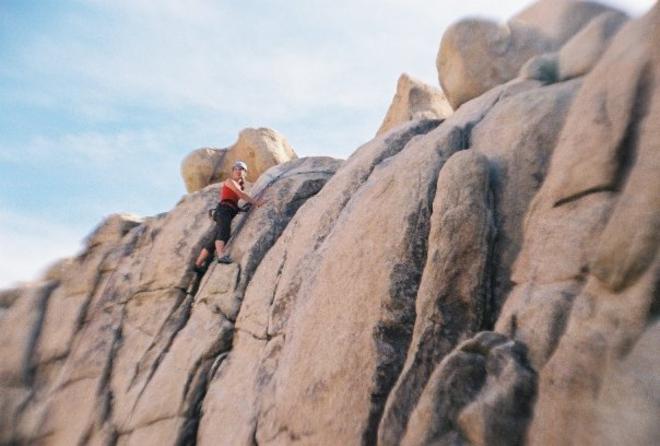
rock climbing jtree

Joshua Tree, California

My first piece has been published on the Outdoor Minded Mag website! I also did the layout, of which I am quite proud. It’s really fun to mess around with making things look just how you want them on the page, and I can spend hours tweaking spacing and sizing… it’s amazing how much time passes when you’re moving pictures around.

This piece has been in the works for quite a long time, since the last time I went climbing in the Red River Gorge in Kentucky, which was a few years ago (2010 I believe…). It started as a journal excerpt, written as we were driving back to and from the climbing sites, and added to while waiting for pizza at Miguels after a long day of climbing (the pizza shop/campground/place to buy any gear your need or want/hang out for climbers in the Red– Miguels Pizza and Rock Climbing Shop). I had wanted to finish it for a while, but other things got in the way (life is annoying like that sometimes). Glad I could finally get it done, and especially excited that I could get it published and share it with everyone!

Here’s an excerpt:

Rock climbing is like an infection, some tiny bacteria that snuck in through a cut, multiplied, and almost without knowing it you’re speaking the lingo—words like “beta” and “redpoint” and “crimper.” You’re wearing the unofficial uniform of patched down jackets and ratty torn pants, spending hundreds of dollars on ropes and carabiners and bits of webbing and tight uncomfortable shoes, driving hundreds of miles so you can haul yourself up hundreds of tiny ledges and holds. It’s hard to figure out why you do this. It’s also hard to rationalize why being a climbing bum isn’t a good (long-term) life choice. – See more at: http://outdoormindedmag.com/why-i-climb-2/#sthash.w5bxg7OG.dpuf

Check it out, “like” it, share it, tell everyone you know! And do the same for OMM, because it’s an awesome magazine that everyone should read on a daily basis. Especially because I’ve now edited two pieces (and written one), which are contributing to the general awesomeness.

Link: Why I Climb

climbing red river gorge kentucky

Red River Gorge, Kentucky

The Flight of the Albatross

Written in 2009, about my trip to the Galapagos Islands in 2008.

Waved Albatross Galapagos Islands

Waved albatross, Galapagos Islands, 2008

There is a place where the wind blows and lifts. Cliffs on the ocean, looking down on the rocks and marine iguanas, sunning, swimming. The rocks look sharp, young, fresh. Untouchable, distant. Albatrosses walk up, a side-to-side gait, comical with their serious eyes. They reach the edge, spread broad, long wings, longer than they looked, so light, just feather and hollow bone, but strong, so strong for flight. They fall up. The wings are a parachute, the wind a friend, the air comforts, supports, pushes and pulls, holds. The giant bird floats along, moves past the rocks, the shrubby grasses, past life, from the center of vision to the periphery, a distinct form to a small dark dot, moving, moving, gone.

To follow—the urge is there. Spread arms and legs, spread dreams, spread soul, and let go. To move away from everything known, into the unknown. To trust, to fly. Is it the flier moving and the word standing still? Or the world moving past in an eye-watering blur and the flier, the bird, held in place, held frozen for a time, measurement suspended? But which way is the fall—up or down? Towards the stars or the rocks—similar, similar; just a difference of distance and iguanas. There is the other choice; to stay. The least attractive, the least risky, perhaps, for the moment.

How long does the moment last until the next? A picture does no justice, cannot capture the vitality of the actuality, the breath of the moment. There is only an idea left, a memory of a feeling, a sense of the wonder and the wild, of the perfectly regulated space of time when albatrosses fly.

Galapagos Islands albatross

Waved albatross, Galapagos Islands, 2008

Rainstorm

Written during my field job at the H.J. Andrews Experimental Forest, near Blue River, Oregon, May-July 2010. All pictures were taken in the Forest. 

IMG_4492

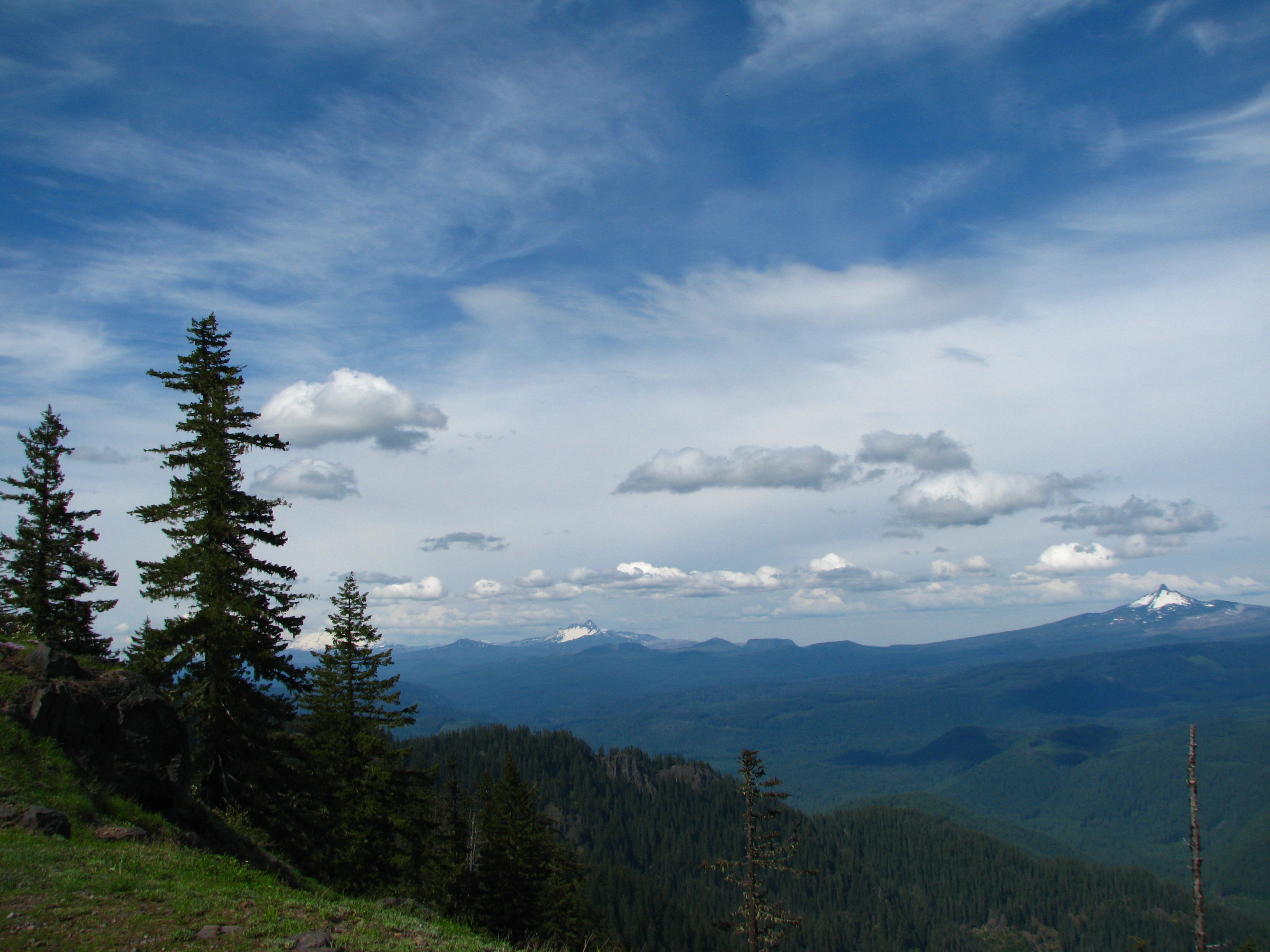
View from top of the ridge.

A thunderstorm brews in the mountains, and the air is a constant exhalation through the cedars and pines, keeping them on their toes. The sound is a mountain stream, glacial melt-waters rushing away to their destiny. The light is expectant, dim, setting the stage. Something mighty this way comes.

Clouds roll with gentle thunder, starting softly and picking up speed and sustenance, a small rock starting the avalanche. Now the rain, a fine mist that moves in sheets, drifting among the swaying trees. The agitated buzz of a rufous hummingbird zips away, seeking shelter. There is a nervous excitement to the air, a taste of expectation on the wind.

IMG_4007

Though there is violence about, an almost peaceful quality pervades. The trees sway gently but will not fall, not today. They are supple, mighty beings; they lean into the winds with their own definition of grace. The relentless grace of the mountain forests, of steady rain. An angry grace, defiant, compliant. A peaceful grace of trees who have weathered a thousand rains, who will weather thousands more. These trees, soothing movements among suspended droplets, silently dampening bark slowly darkening.

IMG_3683

A Stellar’s jay’s harsh clatter disrupts the hypnotic quality of the rain and the wind and the trees, and the storm flows on.  Wind and water, flowing through the sky, soaking the trees and making them dance, to the accompaniment of tympanis, low drum-rolls in the mountains.

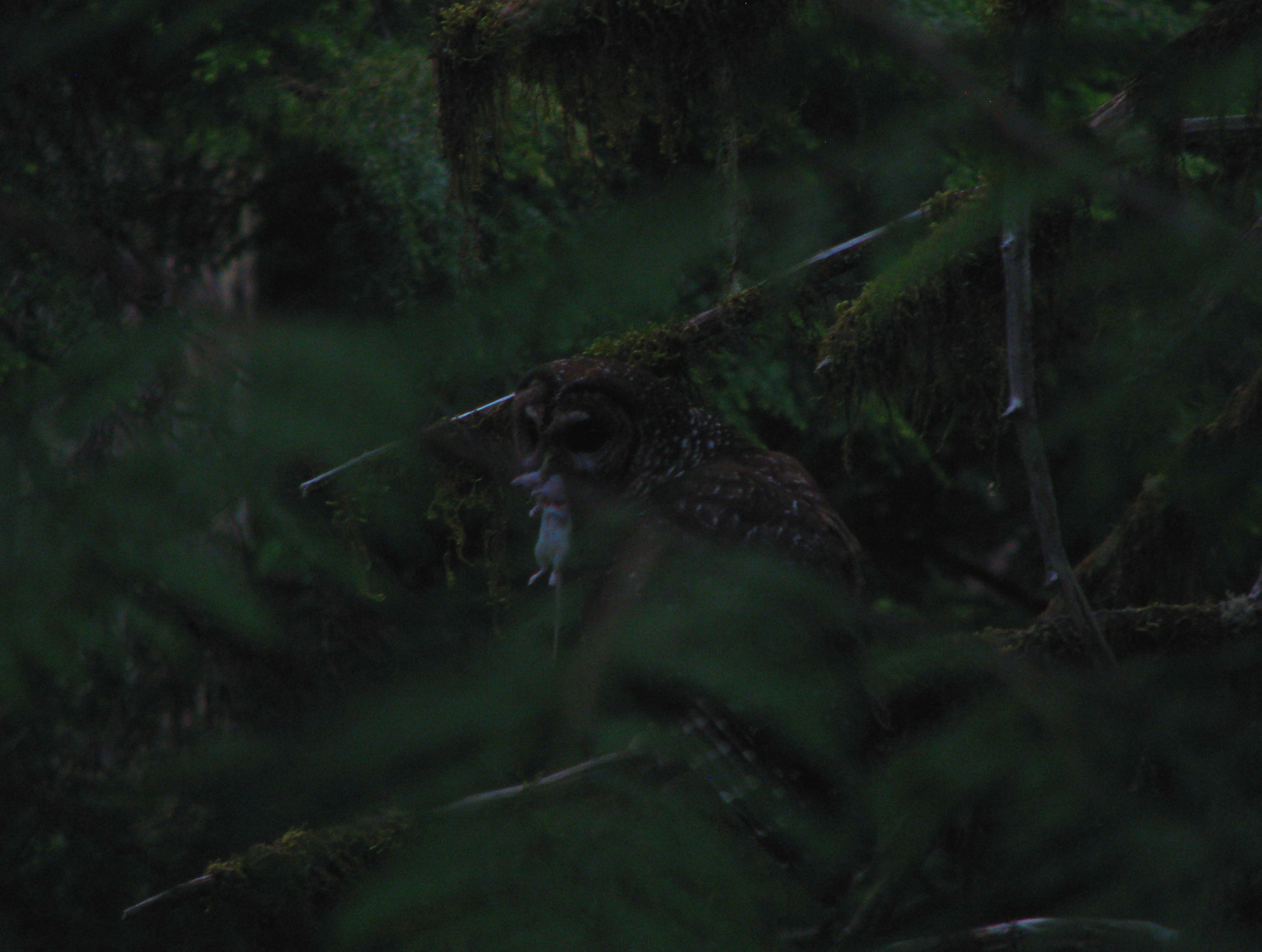
spotted owl with mouse

Black Balsam

written in North Carolina, 2010. 

Memorial Day in the Mountains

It is listening that puts the world right again. When I listen to the wind, gently rustling the grasses, a feeling of peace pervades my being, as if I am absorbing the motes of tranquility that float in the air.  Occasional large flies and bees drone past, overlaying the background murmuring of grasses with percussive buzzes. An eastern towhee calls, moving further and further away, a penny-whistle of startling clarity. Crows caw dryly from among the mountains behind me, harsh sounds against the omnipresent breeze. They ride this wind, watching over places I’ll never see. But here, up on the top of the world, everything that I can see is enough.

I’m sitting on a rocky outcrop at the top of Black Balsam, a mountain just off the Blue Ridge Parkway in North Carolina. The rock under my hand is dark, shot through in some places with quartz, in others sprinkled with bits of mica that shine in the almost-setting sun. The rock is rough but worn, and I wonder how many years have passed since it first felt the warmth of daylight. More than I can fathom. Thousands of feet have passed this way, but this evening the perch and view are mine alone. My rock is an island surrounded by waves of bristling golden grasses, a bald above the tree line. Exposed to the world and the elements, I sit and breathe. The crickets have begun, their sounds the string section hidden among the dried grasses. The towhee still calls, now beyond the far ridge. It has found a partner and the two duet quietly, eventually fading into silence.

I like the mountains

I open my eyes and look up into the pure blue that is the sky. There are clouds, small puffs of cotton over distant mountains, too far away and wispy to be of concern. The moon is a translucent orb, suspended in the lightest blue above the darker mountain-defined horizon. All around me, as far as I can see, are mountains. Their smoothly rounded profiles deceptively hide distance and rock, making the world look soft. I imagine tracing their shapes with my hands, but it takes more than touch to know a mountain.

I glance up and a kestrel flies toward me, the only moving creature I can see. It disappears below the crest behind me, only to climb high again before eventually disappearing, a black speck absorbed into the sunlight and the blue of the sky. I wish to follow, but my mind is drawn back by the large, startling green katydid that lands on my bare leg. It takes a few hesitant steps on feet so small I can’t feel them before wiping its antenna and hopping clumsily away. It lands on the rock nearby, and as I watch it scrapes a wing against its back leg, beginning a solo not intended for my ears. I move closer but it leaps madly away, just out of reach. I don’t try to follow. I look back up at the moon and at my shadow on the grass, which remains still no matter how the grasses dance in the wind.

I sit and listen to the moon and the mountains, and, sometimes, I think I understand what they say.

I like the mountains

A Walk Through the Backyard

On the deck, just outside the sliding-glass door, there are red specks in the snow, either cayenne pepper flakes or blood my younger brother Eric says. Mom puts pepper in the bird seed to keep away the squirrels, and it works. Our cat Jasper caught a dark-eyed junco from the feeders yesterday, played with it on the deck just outside the door. I wish I was strong enough to have gone out and ended its misery. But I’m not.
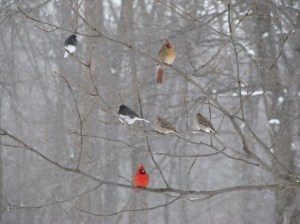
Northern Cardinals, Dark-eyed Juncos, House Finches

Northern Cardinals, Dark-eyed Juncos, House Finches

In my ski jacket, knit hat, scarf, mittens, wool socks and boots, I’m sufficiently bundled to take this walk. It’s 26°F outside. Cold, with a subtly biting breeze.   I wish it was snowing. The sky is a bright muted gray, a shade brighter than depressing. I’ve left the dog, an elderly yellow Labrador retriever named Bogie, sleeping on my bed upstairs. I head out alone.

When I first step out of the garage, I hear birds. Close by, I hear the chirrup cheeping of house finches in the brambles, the tapping of a downy woodpecker on a hickory tree, a white-breasted nuthatch deeper in the woods, calling. In the distance there is a crow, brittle cawing muffled by the snowy trees. I hear black-capped chickadees, a cheery dee-dee-dee-dee in the higher branches, maybe 12 feet off the ground. A tufted titmouse flies from the birdfeeder on the deck to a nearby tree, watching me. I see three blue jays, higher up than the chickadees, in the bare branches of an oak. There are woodpeckers, I don’t know what species but probably downys, tapping on trees in three different directions around me. My legs are getting cold, so I keep walking. Haven’t made it past the driveway yet. The snow makes a crisp muffled sound underfoot. I walk towards our barn, which is just in front of the woods behind the house.

In the big pine tree just in front of the barn, maybe 200 feet from the house, I find a family of black-capped chickadees, four birds hopping from branch to branch, just off the ground and then up, higher, midway up the tree, 20 feet up, and then back down, down to where I could reach, five feet off the ground. I walk in the tracks Mom, Eric, and I made with our cross-country skis three days ago. The track edges are soft from the most recent snowfall, just yesterday.

As I walk pass the barn, I look through the tree line to the Medzuich’s yard. They have a horse now, wearing a blanket coat, grazing in a small paddock in their front yard, which is in line with our backyard. Between their yard and the road is a stand of tall pines, easily 70 feet tall. Barred owls regularly show up in these pines, sometimes waking us in the night asking ‘whoo-cooks-for-you, whoo-cooks-for-you-all?’ In high school, I was late for my evening dance class more than once because I was mesmerized by a staring barred owl, sitting midway up a pine on the edge of the stand. I remember when their property was a field, where corn and wheat grew. I remember before there was a horse, a house, a driveway.  Eight years ago? Nine? It doesn’t matter.

Behind our barn, colored the classic red of all barns, there are stacks of logs covered in snow, waiting to be split into firewood for next year. The summer after my senior year of high school, when I couldn’t find a job, my dad paid me to paint the barn. It was miserably hot, and the paint would dry on the brush and in the tray before I could get it on the walls. Dad and Eric will use the home-made Frankenstein-looking log splitter, which they bought from the former neighbor across the street, Mr. Barth, to turn the huge log rounds into kindling and pieces suitable for the furnace and wood stove. There are holes in the siding of the barn, where a northern flicker tried to make a cavity or look for insects in the treated wood. Dad wasn’t happy about that. Below the holes, the siding on the back corner of the barn is cracked from where Eric ran into it with the tractor. Dad wasn’t happy about that, either.

I hear a noise and look up to see tundra swans, flying overhead in a check-shape formation; one leg of the V is longer than the other.  I count 28. Before this year, I’d never seen flyover tundra swans, not here in the backyard. They spend the summer in the Arctic, and these overhead are heading to the East Coast for the winter. The pond behind our house isn’t big enough to tempt them to land. I wonder if they can even see it, surrounded by the tall hickories, oaks, ash, tulip poplars, and maples that make up the woods.
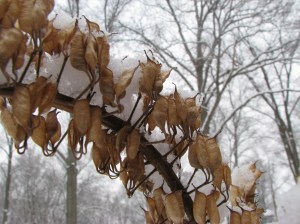
IMG_1570

I take a few more steps and leave the yard, striding onto the path that goes through the woods behind the barn to our small pond. There are sprays of dirt here and there, where squirrels have been digging for buried caches of hickory nuts. In the woods are shorter oaks with pale, shriveled leaves that shiver in the wind.

A dead squirrel is on the path. There are bits of fur in piles, scattered in a foot radius around the body. The tail has been ripped off and the body is twisted into a ball. At first inspection, I though the head was gone, but it’s just curled into the stomach, as if the dead squirrel was trying to sleep. The cold wind blows, making the oak leaves rustle. Crows, two or three, call from the direction of the pond, further off in the gray trees. There is urgent woodpecker tapping behind me, Morse code I don’t understand. The body is frozen hard; I nudged it with my boot. It is a large squirrel, with brown and gray fur, probably a fox squirrel. Any tracks around the body are hidden in the trampled snow of the path, so I have no idea what did this squirrel in. Hawk? Or mammal? And why was it left, not finished off? A squirrel tail can’t be filling. In the cold, you need all the food you can get. It can’t be easy to be a predator in the winter. I get cold again, and move on down the path, further in the woods towards the pond.

My footprints from yesterday contain fresh deer tracks. There are deer tracks everywhere, in paths leading off into the trees, straight lines winding on unknown business. Yesterday I saw two deer bounding away, deeper into the woods behind the pond. Eventually, if you keep going in that direction, you reach the highway. Miles away from our property, but not as endless as I once thought.

I stop and place my bare hand on an oak tree. The bark is soft and corky, and not as cold as I thought it would be. If I push hard enough, in just the right way, I feel I could press my hand inside. Is it warm in the center of a tree? A blue jay calls, once, twice, three, four times. Where are the others? If a tree had a mind, what would it think about?
IMG_1567

Even though I am in the woods behind our house, yard, and barn, I can still hear cars as they pass on the road in front of the house, which is only about 3/4ths of a mile away. No matter how hard they try, the birds can’t drown out the sounds of the traffic. I keep walking along the snowy path in the woods, past a deer stand nailed up in a tree. It belongs to the Reininger’s, the neighbors that live behind us, back in the woods. There are inches of snow on top, and it hasn’t been used in years. The deer don’t even try to pretend to be frightened too much anymore.

I continue along, following the path through the trees. There are squirrel tracks in the snow, bounding from tree to tree. The snow is shallower in the woods than it was in the yard, here only a few inches deep, ankle deep. I stare out at the trees, and I hear birds calling. White-breasted nuthatches, crows, black-capped chickadees, dark-eyed juncos. Without meaning too, I note the species, direction, distance. My bones are getting cold. My mind is spread flat on the ground, surrounding the trees like snow cover. Each inhale makes the rims of my nostrils ache. My cheeks feel rosy, red, and raw.

I cross over a trickle of water, a streamlet draining from the lower ground behind the pond to the ravine deeper in the woods, and there are grains of hoarfrost in frozen footprints. The path takes a slight incline up to the pond from here, a mountain if you’re Eric on cross-country skis, five steps to the top. For anyone else, the elevation change of roughly three feet is barely noticeable. Looking up, a black-capped chickadee does aerobatics in the tiny thin bare branches of a nearby ash tree. Three of its friends and family are nearby, watching. I can hear the scrape of the snowplow on bare pavement as it drives by on the road.

The pond is finally frozen solid, with an opaque under-layer to the ice, hoar-crystals on top, looking white and deceptively stable. Once, when we were little, at least a couple feet shorter than we are now, Eric and I fell through the ice by the dock. The ice was solid, but not strong enough to hold our combined weight when we stood next to each other. I pulled him out. I might have been in elementary school, and he’s four years younger. I remember it being cold. The water was dark, black, I couldn’t see my feet hit the bottom.

Leaving the pond behind, I take the path back through the woods, towards the barn, yard, and house, towards the warmth. I’ve never counted how many steps it takes, but I’ve been this way thousands of times. My body knows how long it feels to walk from the pond to the yard, to the house. I measure the distance in body-time, in heartbeats and breaths. Now there are blue jays in the big pine in front of the barn, which fly away once I see them. The feeders on the deck are empty but swaying, something scared the birds off. Me? They’ll return soon enough to eat their cayenne pepper-laced seed. In the garage, I stomp the snow from my boots and head inside.
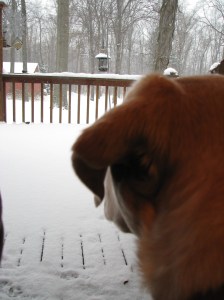
Bogie looking out across his domain

Ohio Winter

One winter Saturday, one of those cold Ohio days in late December or early January, my dad reads an article in the Akron Beacon Journal about bald eagles in Cuyahoga Valley National Park. We decide to find ourselves an eagle, an excuse to go outdoors. You need a purpose to go out in the winter in Ohio, there’s no going outside just for the sake of being outside. Without a reason, or once the reason is forgotten, the frigid bleakness soon saps your body heat and spirit, and ice starts to form in your veins.

We bundle up, Dad and my younger brother in their winter Carhartt jackets, dirty from splitting and stacking wood in the backyard. I wear my ski jacket, the one I got in high school when I learned to ski at Boston Mills. We grab our wool hats and binoculars, jump in the truck, and take the long way through the Valley to Ira Trailhead, one of our usual starting points along the Ohio and Erie Canal Towpath Trail. There is one other car in the parking lot.

On the trail we head south and within five minutes we see our first bald eagle, perched on a bare branch over the Cuyahoga River. The water is brown and sluggish-looking, the white foam along the edges frozen. After a few minutes of passing the two pairs of binoculars between the three of us the eagle flies away, heading downstream. We decide to continue on, to give chase. Bald eagles aren’t uncommon here, but we don’t always see one when we come. We’ve never seen one, let alone two, in such a short amount of time. I follow in Dad’s tracks, stepping in each footprint like I did when I was little, only now I can match his stride and our feet are nearly the same size.

Another five minutes and we find another eagle, probably the same one. It’s found a companion, and the two sit in adjacent trees, silently staring out at the world. When they eventually decide to fly away they head away from the river and the Towpath. We retrace our steps back to the promised warmth of the truck, walking along someone’s cross-country ski tracks. The muted sun is on its way down. We can barely see our breath in the dusk.

At home, we eat pizza in the family room, watching television. There is a fire in the wood stove and the pets gravitate towards the warmth, lying on the hardwood floor almost touching the stove itself. We linger on the couch, no one wanting to leave for colder beds. The snow is falling softly outside, turning the track-filled yard to a clean slate, a sparkling white canvas where the deer and songbirds will write their stories.

Right now there is nothing to see through the dark windows; they’ve turned to mirrors, reflecting the firelight and TV light, reflecting us on the couch sitting together on a cold winter night in Ohio.

Merle’s Door: Lessons from a Freethinking Dog

I just got back from spending 13 days in the Yellowstone/Grand Teton area with my family. There will most likely be a series of blogs about this epic travel journey (and epic it was) once I go through all my pictures and videos, which may take days. I take a lot of pictures.

While you’re waiting breathlessly for my next post, read this book: Merle’s Door: Lessons from a Freethinking Dog, by Ted Kerasote. It’s quite good. Excellent, really. I picked it up at a Goodwill somewhere, liking the picture on the cover (Merle the dog on a mountain top) and I’m glad I did. I’d even consider paying full price for this one, which is saying a lot since I buy most of my books from Goodwill for $1 or less.

Bogie is particularly enthralled with the book.

However, I would not recommend reading the ending on a plane, especially not while sitting between a middle-aged man and a just-barely-post-adolescent man, both strangers. I cried. Twice. Well, I did manage to keep in the body-heaving sobs, but my eyes definitely teared up. If this book doesn’t at least give your heart a wrench, you probably don’t have a soul. I don’t normally cry when I read– in fact, I can’t really think of any other time reading when I was tempted to (not even when J.K. Rowling offed Dumbledore- but I think I was in shock)– so that says something about the poignancy of the subject and the writing.

The book is set out West, primarily in Kelly, Wyoming (in the shadows of the Tetons, where we were on vacation). Basically, the book is about Ted and his dog, Merle, and their lives together, starting when Ted finds Merle in the Utah desert and ending with Merle’s death (hence the plane sobbing). The book not only follows the relationship of Ted and Merle, but also delves into the relationships between people and dogs, where they originated, and how those relationships have evolved since then. Excellent writing, excellent subject, excellent book.

Our pets have it rough in the Smith household.

From the prologue:
“This is the story of one dog, my dog, Merle. It’s also the story of every dog who must live in an increasingly urbanized world, and how these dogs might lead happier lives if we changed some of our behavior rather than always trying to change theirs.
…[W]hat he taught me about living with a dog can be applied anywhere. His lessons weren’t so much about giving dogs physical doors to the outside world, although that’s important, but about providing ones that open onto the mental and emotional terrain that will develop a dog’s potential. His lessons weren’t about training, but about partnership. They were never about method; they were about attitude.And at the heart of this attitude is a person’s willingness to loosen a dog’s leash– in all aspects of its life– and, whenever practical, to take off its leash completely, allowing the dog to learn on its own, following its nose and running free.”

Ted Kerasote’s website, with information about this book and his others, including newer books about his dog after Merle:

Merle’s Door: Lessons from a Freethinking Dog, by Ted Kerasote.
c. 2007 by Harcourt, Inc.