What is a mist net?

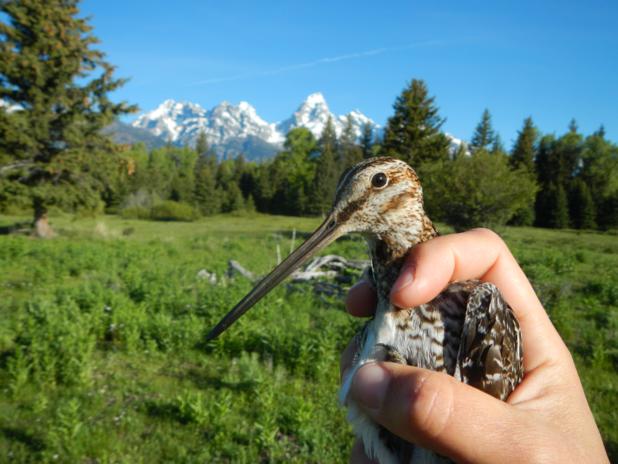
A Wilson's Snipe with the Teton Range in the background.

A Wilson’s Snipe with the Teton Range in the background. Snipe use those long bills to probe in the mud for food, like insects and other invertebrates (little squirmy things without backbones).

Sometimes when I tell people that I band (and therefore catch) birds, they get real quiet and look at me strangely. Do you use a fishing pole, a butterfly net? Cages? Hold out birdseed in your hand and wait for them to land, then use super-fast reflexes to grab them? I’m working on that last one, but no. We use these nifty thingies (a scientific term, by the way) called mist nets.

I handled my first mist net back in 2005 when I was a freshman in college (oh so long ago), so I’ve sorta forgotten that most people aren’t familiar with what one is. That’s the problem when you spend too much time hanging out with bird biologist types, you can use words like “mist net” and “trammel” and everyone knows what you’re talking about, and when you get jump-up-and-down excited about a Wilson’s Snipe or a Song Sparrow they’re right there jumping with you. Some people get into sports teams, I get excited about their bird namesakes. To each his own.

But before we get in too far:

Do not attempt this at home unless you are a trained professional.

And I mean it. You have to be registered with the government (USGS) to catch and band birds, which requires a license, research permit, and proper bird-handling training. The Migratory Bird Treaty Act makes it illegal to “take, possess, import, export, transport, sell, purchase, barter, or offer for sale, purchase, or barter, any migratory bird, or the parts, nests, or eggs of such a bird except under the terms of a valid permit issued pursuant to Federal regulations.” The term migratory bird here includes just about every native species, so basically: if you see a bird in the wild, leave it alone. To see a complete list of the species covered and for more information, click HERE.
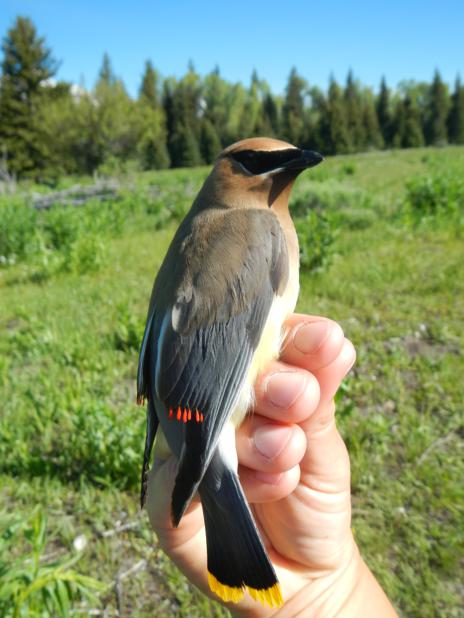
A Cedar Waxwing. Note the waxy tips on his wing feathers. No one knows exactly why some waxwings secrete these tips, but they sure do look cool (and maybe help attract the ladies).

A Cedar Waxwing. Note the red waxy tips on his wing feathers. No one knows exactly why some waxwings secrete these tips, but they sure do look cool (and maybe help attract the ladies).

We are trying to gather important information about bird populations, but first and foremost is bird safety. So if you ever come across a mist net with a bird in it, leave it alone. Don’t touch it. Someone will be coming along soon to safely get the bird out, I promise. Well-meaning passersby can seriously injure birds by touching them and trying to “help.” Would you go into a hospital, walk into surgery and start poking around in a patient? No, of course not. You need training to perform surgery– which is my point exactly.

If you’d like to read a 66 page document put out by the Ornithological Council entitled Guidelines To The Use of Wild Birds in Research, click HERE. The last page also details the American Birding Association’s Code of Ethics, which are a must-know for all birders and anyone interested in observing birds in the wild.

And now, after our brief safety interlude, on to the good stuff:

What Is A Mist Net?

A mist net is a very fine net that we set up to catch birds. It looks like mist, and is a net, so we call them mist nets. Except they don’t actually look like mist. Imagine four 39.37 foot long hair nets (or 12 meters, since scientists reasonably use the metric system, unlike the rest of the US) strung between two poles, the bottom of the top one touching the next, and you have a fairly good idea of what a mist net looks like. Our nets are about 7-8 feet high, depending on how much we stretch them out, a guestimation based on the fact that we use 10 foot poles to string them on.
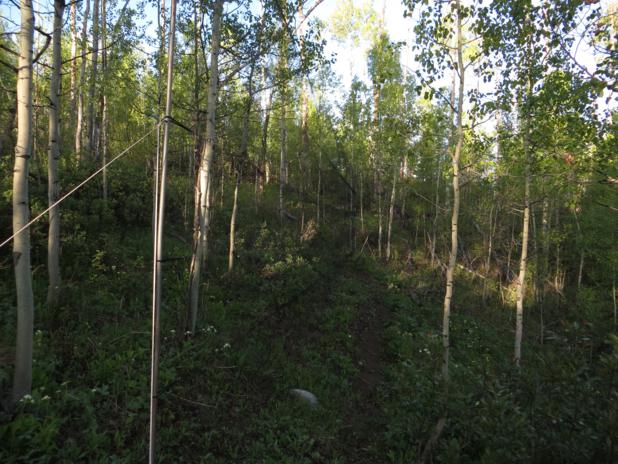
Picture borrowed from my co-bander Bo. Can you see the net stretching from the pole (going right)?

Picture borrowed from my co-bander Bo. Can you see the net stretching from the pole (going right)? It’s rather difficult to get a good picture of a mist net, since they are so fine and hard to see.

There are five thicker strings, called trammels, that have loops on either end and are what attach the net to the poles. Between the trammels stretch the mesh netting, which is fine enough that, once the net is spread open, is almost invisible (I’m guessing this is where the “mist” part of the name comes from). The netting forms a little bit of a pouch between each trammel, and when birds fly in they sometimes hit the net and fall into this pouch.

We use smaller-meshed netting (there are different sizes depending on what type of birds you are targeting; we’re trying to catch everything that will fly into the nets), and so larger birds usually don’t become too tangled in the mesh but instead are trapped in the pouch. Sometimes they can get themselves out before we get to them by flapping their way down the net until they get to the edge by the pole and then escaping.

The nets have give to them, so when birds fly into them they can bounce a bit, somewhat like the safety net below acrobats at the circus. I’ve watched birds fly directly into the net and bounce out, not getting caught at all.
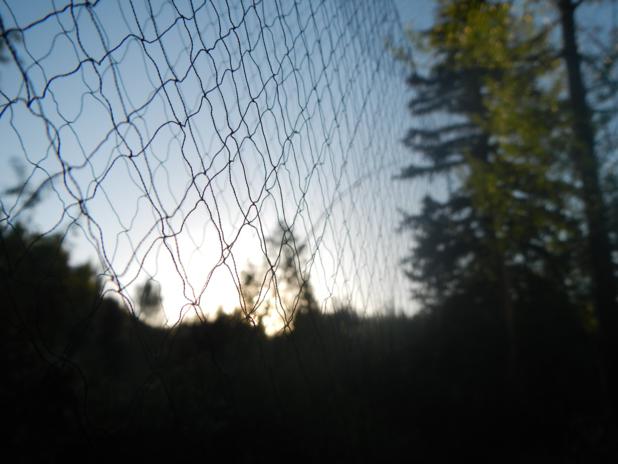
Close-up of a mist net. Note the small mesh size.

Close-up of a mist net. Note the small mesh size. I frequently get my fingers tangled while trying to extract birds, one of the hazards of having big hands.

Smaller birds, like House Wrens and Black-Capped Chickadees, can almost fit completely through the mesh, and can become more tangled in the netting that larger birds (American Robins being an exception, the turds. And I mean that in a completely scientific way– their scientific name is Turdis migratorius, so we call them turd birds– from Turdis, of course, has nothing to do with the fact that they also they also tend to poop all over the place. The middle schoolers love it when I tell them that).

When we check the nets, we have to very delicately untangle the birds from the netting, which, depending on the species and the individual bird, can take anywhere from a few seconds to a few minutes. In my experience, warblers typically are easier, because they hit the net and don’t struggle too much and so aren’t too tangled. Wrens, on the other hand, like to thrash around, trying to extract themselves, and can sometimes spin themselves around in the net, so that they look like little balls of black netting with a head and feet poking out.

Usually we are able to quickly untangle the birds without hurting them or the net, but sometimes they become so tangled that the only way to extricate them safely is to cut the net. We carry small scissors and toothpicks, or sometimes crochet hooks, to use to slip the net off birds sometimes when our giant human fingers are too big to manipulate the thin netting off a tiny warbler or kinglet wing.
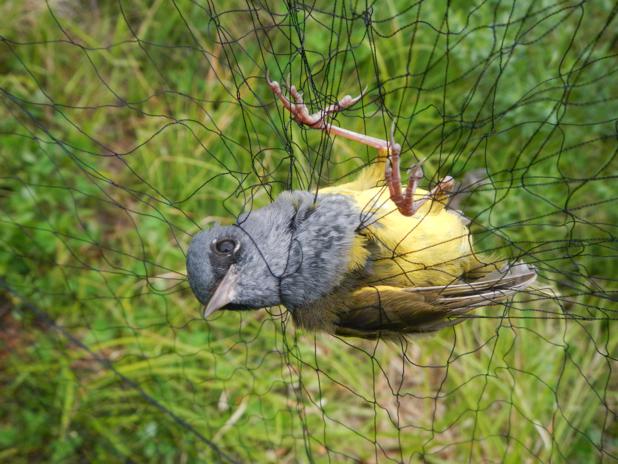
A MacGillivray's Warbler in the net. It took me less than a minute to safely extract (untangle) him.

A MacGillivray’s Warbler in the net. It took me less than a minute to safely extract (untangle) him.

There have been studies done to determine the safety of mist netting, and one study found that “Of 620,997 captures the percentage of incidents of injury amounting to 0.59% while only 0.23% of captures resulted in mortality.” They also found that birds that were recaptured more frequently were at less risk than birds only captured once. For more information, follow this link:

How Safe is Mist Netting? First Large Scale Study into Bird Capture Technique Evaluates the Risks

If you’re in the Grand Teton/Jackson WY area and would like to come out and see what we do at the banding station, join us for a Feathered Friday. There is a fee, but you get breakfast in addition to a visit with some fantastically amazing, beautiful, smart, witty, very-happy-to-be-up-at-4am- bird banders. Keegan, our crew leader, will also be there. He is just as cool as the rest of us, though maybe not quite as fantastically beautiful. (The rest of us on the crew are women, so poor Keegan has to put up with a lot sometimes).

Hope to see you around the banding station sometime, but if not some of my coming blog posts will definitely include our banding happenings, so stay tuned!

tss-logo

If you’re looking for a new blog to read, check out this one by Bo D’Amato. She’s my bunkhouse mate/roommate/fellow bander, and has a cool blog called The Eco Explorer. Check it out– there’s at least one picture of my hands holding a Wilson’s Snipe on there.
Bird Banding with the Teton Science Schools

So here I am in the Tetons, about to start a three month stint working for the Conservation Research Center of the Teton Science Schools (TSS). I am working with the bird banding crew, and our job is to catch birds at five different sites; three around the town of Jackson, Wyoming, and two in the Grand Teton National Park.

view of the grand_618x374

Our sites are in both developed and undeveloped areas (the ones in downtown Jackson are interesting, as we sometimes get homeless people hanging out in our net lanes). One goal of the project is to see how songbirds respond to different levels of development, by comparing our data from site in the park (which are undeveloped) and those in downtown Jackson (located in the middle of housing developments and surrounded by busy roads). There have been 21 years of banding going on through the TSS, and it’s exciting to be contributing to such long-term research.

I’m still learning about our particular project, but if you follow the link above it will take you to the CRC website, which has a nice little description of our research. I will also be sharing more as the season goes on, so stay tuned!

anya with ssha_464x618

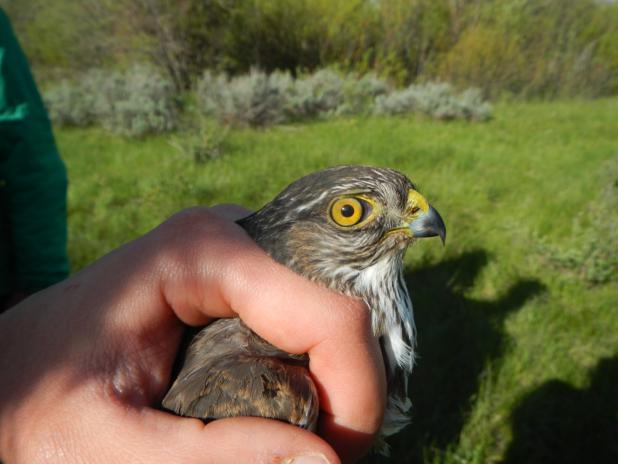
One of our volunteers, Anya, with the male sharp-shinned hawk.

We’re still in training at the moment, but official banding starts on Friday. I’m excited. Our first day is at one of our sites in the park, and Jenny, our boss, has said they typically see the most wildlife at that site, including moose, bison, bear (black and grizzly), and white-tailed deer. But don’t worry Mom, we were all issued bear spray yesterday and trained in its use. I’m hoping never to get close enough to spray down a grizzly, but it’s good to know the spray cannister works.

During our most recent practice banding session, we caught a couple of exciting birds (all birds are exciting, but these were especially so. They also might have been the only ones I remembered to take pictures of…):

First was this male Sharp-shinned Hawk

DSCN6105_618x464

And this older male Lazuli Bunting, who was absolutely gorgeous:

lazuli bunting_613x464

(links in green will take you to more information about these species)

Can’t wait to see what else we catch in our nets this summer!

Lost in the pines

Written in Yellowstone National Park, Wyoming, July 2012

Wyoming rainbow

The lodgepole pines grow incredibly dense, packed in just inches away from each other.

They make a solid, living wall of green and needles. I wonder what it would be like to slip between the trunks and lose yourself. You wouldn’t have to go very far to be lost from sight.

How far would you have to go to find yourself again?

Arches

storm sky in arches

We are driving through Arches National Park, and it’s raining. There are big flashes of lightning here and there, but I can’t hear if there is any thunder. The car windows are rolled up against the rain. The gray clouds and sky make a different backdrop, one I like better than the normal clear blue skies. There is more emotion, more drama. This is what this place stirs in me, varied emotion, varied feelings, the gray mottled churning of the sky.

This place is not as simple as a cloudless bright blue sky.

Neither am I.

clouds in arches


The eyes of this place

Canyonlands National Park


“To stare directly into the eyes of a place like this, to not look away, is nearly unbearable.”

Craig Childs, from the book  Soul of Nowhere

waiting in false kiva


Max and I spent quite some time here, photographing and getting to know this place, in Canyonlands National Park, Utah. We also sheltered from a few rather large thunderstorms here, and watched some fantastic lightning shows from the comfort and safety of this cave in the canyon wall.

Check out his much better photographs on his website: Max Seigal Photography

Horseshoe Bend, Arizona

Horseshoe Bend AZ

Max getting ready for sunset by gazing into the sky, in the wrong direction. The sun sets over the bend in the river, straight across from where we stood on the rim.


We spent about a day in Page, Arizona, saluting the day both at its end and beginning from the rim of Horseshoe Bend, a “horseshoe-shaped meander of the Colorado River.” We made the mile-long trek to the edge of the canyon rim, overlooking the water below by about 1,000 feet. There are no railings, so you are left with only your own common sense to protect you from going over the edge.

Horseshoe Bend, AZ

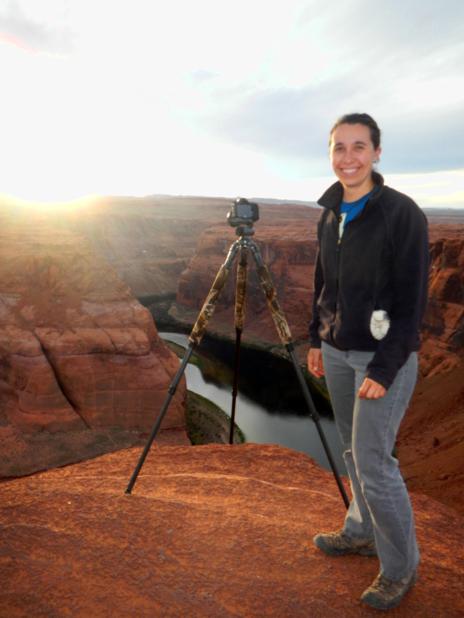
Pretending to be a photographer, and being very careful not to stumble and knock the tripod over the canyon rim.


It’s windy here on the rim of Horseshoe Canyon, and the wind blows sand in our faces, camera lenses, and down one thousand feet to the river below. I can see the wind ruffling the surface of the water. It’s not really cold, just when you’re sitting still the wind gets to you, blowing your warmth away across the desert. The sunset tonight was all a photographer could ask for, streaks of pink clouds, blues and purples, orange. I hear violet-green swallows flying below me along the canyon walls, and lower still I see a soaring raven, which from my perspective looks the size of an ant, an ant with a paraglider.


Horseshoe Bend, AZ

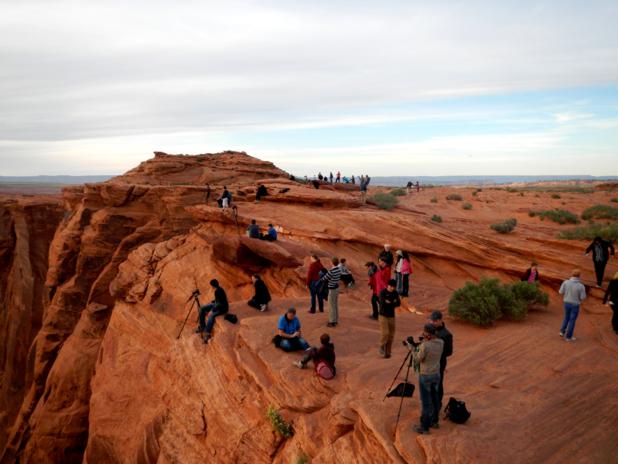
Some of the people who joined us to watch the sunset. After I took this picture, more people arrived, until there were at least 100 total loitering on the canyon rim.


I’m sitting on the edge, much closer than Mom would be comfortable with, my left foot braced parallel a few inches from the edge, the rest of me a couple feet back, no danger of losing my balance. The wind isn’t that strong. As the sun goes down, the people leave with the light. I try to eavesdrop, but most of them speak different languages and I don’t know what they say. They don’t seem to be speaking of the view though, because those who really look don’t say anything.


Horseshoe Bend, AZ

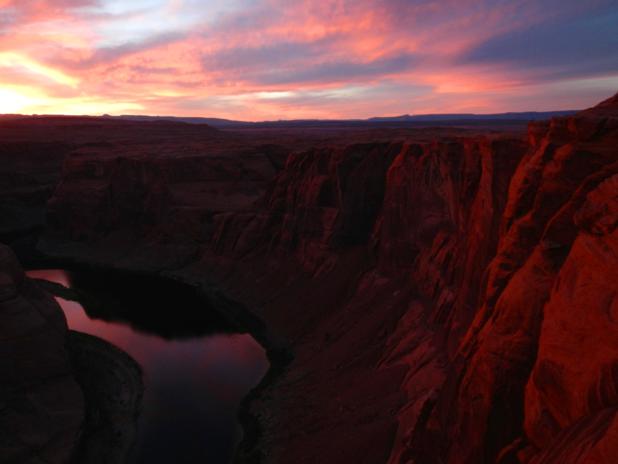
The canyon walls glowed a beautiful orangish/red in the vanishing sunlight, a living color that to me is the essence of this place.

Owachomo Natural Bridge, Utah

Natural Bridges National Monument

I am sitting in Natural Bridges National Monument, at Owachomo Natural Bridge, the last of three natural bridges in the Monument. It is after dark, and I’m waiting for the stars and my friend Max, who is photographing the night sky. In the distance, from their pools in the narrow rock canyon, I hear frogs that sound like sheep and chickens. Bats fly about in quick loops, swerving through the dusk.


Natural Bridges National Monument

The stars above and around Owachomo were visible first. The view through the bridge was cloudy for quite some time, the clouds trapped by the rock ceiling. The wind plays with my hair, and gradually dances my body heat away across the desert, through the bridge, out to the stars. I brought a cushion to sit on, and my sleeping bag to wrap around my shoulders. I have a book to read while I wait for Max to finish his pictures, painting the arch with light so it shows up in his shot.


Every few minutes I turn my headlamp off, let my eyes adjust to the dark, and look all around to the expansive sky of stars. I’d sit here and just watch the night, but I know it doesn’t take very long for me to fall asleep, lulled by the dark, the wind, the reassuring stars all around. I don’t want to fall asleep, not yet, so I read to keep myself awake, engaged, present, and yet not, with my surroundings.


This is the perfect place to read this book, The Soul of Nowhere, by Craig Childs. It is about these places, and blends with them. It gives me another way to connect with this space around me, through the words of someone else who has absorbed this place and knows how to articulate what it means.


Natural Bridges National Monument

… I am hoping to become the same, a person who is changed by the land, who puts a pen to paper and tells what I have seen of this land.”

– Craig Childs, from The Soul of Nowhere

Postcard: View from the road

Dear Mom, Dad, Megan, Eric, and the various animals living in our house,

Howdy from the road! Right now I’m sitting in a McDonalds in Page, Arizona, using the wifi and drinking a frappe. We’re here (Page, not McDonalds) to visit Antelope Canyon so Max can get photos of the light beams. We’ve been there before, in December. You have to pay for a guide since it’s on Navajo land, and our guide last time was a pretty cool dude. He played the flute for us in the canyon, while the photographers were busy taking their shots, and after asked Max if he wanted to take part in some “magic herb” with him and the owner.  Max politely declined. Wonder if they’ll remember us…

the view outside telluride_618x464

Outside of Telluride, Colorado

We left Boulder Sunday evening, and drove up to Aspen, where we camped for the night. Slightly chilly. From there, we went to Black Canyon of the Gunnison National Park (where Max discovered he had left his national park pass at home on the dresser) and then on to Telluride. From Telluride, we headed to Natural Bridges National Monument in Utah for some star photos, and then this morning made our way to Mule Canyon, to take pictures of the House on Fire ruins. The ruins are in a little canyon out in the desert, and it was fun to poke around and explore. From there, we drove down here to Page.

Arizona highway

The highway in Arizona, on the way towards Kayenta

So tonight and I think tomorrow we’re here in Arizona, and then we continue our loop northward, heading back to Utah and hitting up Zion, Bryce, Arches, Canyonlands National Parks, as long as we don’t run out of time. We don’t have to be back in Boulder until May 11th, so we have plenty of time.

Natural Bridges National Monument

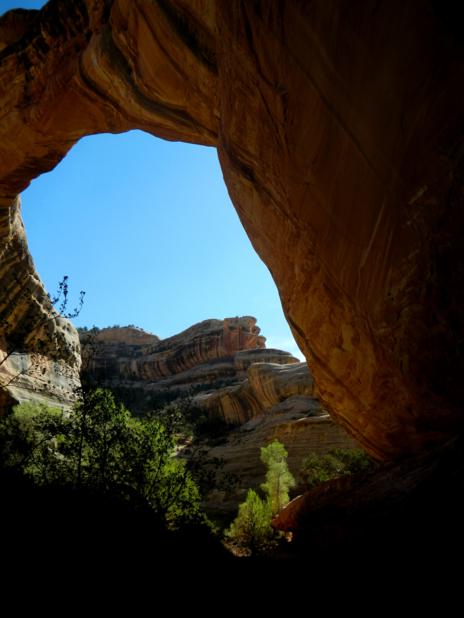
The underside of Sipapu Natural Bridge in Natural Bridges National Monument

Give my Bogie-dog a big back scratch and an extra cookie from me!

Love, Lauren

Fences

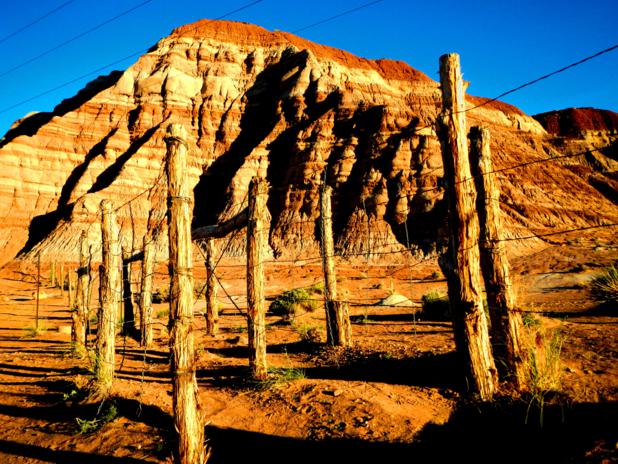
I like fence posts, especially the ones that haven’t been machine cut but are just lengths of wood, branches or twisted small trunks, gathered miles away then set in holes in a row along the highway, strung together with impossibly long stretches of barbed wire. They don’t do much to contain the mountains or the wide open fields or the expanse of sky. Man’s effort, for what? Fences mean nothing to the spirit of this place.

Yellowstone NP