A Walk Through the Backyard

On the deck, just outside the sliding-glass door, there are red specks in the snow, either cayenne pepper flakes or blood my younger brother Eric says. Mom puts pepper in the bird seed to keep away the squirrels, and it works. Our cat Jasper caught a dark-eyed junco from the feeders yesterday, played with it on the deck just outside the door. I wish I was strong enough to have gone out and ended its misery. But I’m not.

Northern Cardinals, Dark-eyed Juncos, House Finches

Northern Cardinals, Dark-eyed Juncos, House Finches

In my ski jacket, knit hat, scarf, mittens, wool socks and boots, I’m sufficiently bundled to take this walk. It’s 26°F outside. Cold, with a subtly biting breeze.   I wish it was snowing. The sky is a bright muted gray, a shade brighter than depressing. I’ve left the dog, an elderly yellow Labrador retriever named Bogie, sleeping on my bed upstairs. I head out alone.

When I first step out of the garage, I hear birds. Close by, I hear the chirrup cheeping of house finches in the brambles, the tapping of a downy woodpecker on a hickory tree, a white-breasted nuthatch deeper in the woods, calling. In the distance there is a crow, brittle cawing muffled by the snowy trees. I hear black-capped chickadees, a cheery dee-dee-dee-dee in the higher branches, maybe 12 feet off the ground. A tufted titmouse flies from the birdfeeder on the deck to a nearby tree, watching me. I see three blue jays, higher up than the chickadees, in the bare branches of an oak. There are woodpeckers, I don’t know what species but probably downys, tapping on trees in three different directions around me. My legs are getting cold, so I keep walking. Haven’t made it past the driveway yet. The snow makes a crisp muffled sound underfoot. I walk towards our barn, which is just in front of the woods behind the house.

In the big pine tree just in front of the barn, maybe 200 feet from the house, I find a family of black-capped chickadees, four birds hopping from branch to branch, just off the ground and then up, higher, midway up the tree, 20 feet up, and then back down, down to where I could reach, five feet off the ground. I walk in the tracks Mom, Eric, and I made with our cross-country skis three days ago. The track edges are soft from the most recent snowfall, just yesterday.

As I walk pass the barn, I look through the tree line to the Medzuich’s yard. They have a horse now, wearing a blanket coat, grazing in a small paddock in their front yard, which is in line with our backyard. Between their yard and the road is a stand of tall pines, easily 70 feet tall. Barred owls regularly show up in these pines, sometimes waking us in the night asking ‘whoo-cooks-for-you, whoo-cooks-for-you-all?’ In high school, I was late for my evening dance class more than once because I was mesmerized by a staring barred owl, sitting midway up a pine on the edge of the stand. I remember when their property was a field, where corn and wheat grew. I remember before there was a horse, a house, a driveway.  Eight years ago? Nine? It doesn’t matter.

Behind our barn, colored the classic red of all barns, there are stacks of logs covered in snow, waiting to be split into firewood for next year. The summer after my senior year of high school, when I couldn’t find a job, my dad paid me to paint the barn. It was miserably hot, and the paint would dry on the brush and in the tray before I could get it on the walls. Dad and Eric will use the home-made Frankenstein-looking log splitter, which they bought from the former neighbor across the street, Mr. Barth, to turn the huge log rounds into kindling and pieces suitable for the furnace and wood stove. There are holes in the siding of the barn, where a northern flicker tried to make a cavity or look for insects in the treated wood. Dad wasn’t happy about that. Below the holes, the siding on the back corner of the barn is cracked from where Eric ran into it with the tractor. Dad wasn’t happy about that, either.

I hear a noise and look up to see tundra swans, flying overhead in a check-shape formation; one leg of the V is longer than the other.  I count 28. Before this year, I’d never seen flyover tundra swans, not here in the backyard. They spend the summer in the Arctic, and these overhead are heading to the East Coast for the winter. The pond behind our house isn’t big enough to tempt them to land. I wonder if they can even see it, surrounded by the tall hickories, oaks, ash, tulip poplars, and maples that make up the woods.
IMG_1570

I take a few more steps and leave the yard, striding onto the path that goes through the woods behind the barn to our small pond. There are sprays of dirt here and there, where squirrels have been digging for buried caches of hickory nuts. In the woods are shorter oaks with pale, shriveled leaves that shiver in the wind.

A dead squirrel is on the path. There are bits of fur in piles, scattered in a foot radius around the body. The tail has been ripped off and the body is twisted into a ball. At first inspection, I though the head was gone, but it’s just curled into the stomach, as if the dead squirrel was trying to sleep. The cold wind blows, making the oak leaves rustle. Crows, two or three, call from the direction of the pond, further off in the gray trees. There is urgent woodpecker tapping behind me, Morse code I don’t understand. The body is frozen hard; I nudged it with my boot. It is a large squirrel, with brown and gray fur, probably a fox squirrel. Any tracks around the body are hidden in the trampled snow of the path, so I have no idea what did this squirrel in. Hawk? Or mammal? And why was it left, not finished off? A squirrel tail can’t be filling. In the cold, you need all the food you can get. It can’t be easy to be a predator in the winter. I get cold again, and move on down the path, further in the woods towards the pond.

My footprints from yesterday contain fresh deer tracks. There are deer tracks everywhere, in paths leading off into the trees, straight lines winding on unknown business. Yesterday I saw two deer bounding away, deeper into the woods behind the pond. Eventually, if you keep going in that direction, you reach the highway. Miles away from our property, but not as endless as I once thought.

I stop and place my bare hand on an oak tree. The bark is soft and corky, and not as cold as I thought it would be. If I push hard enough, in just the right way, I feel I could press my hand inside. Is it warm in the center of a tree? A blue jay calls, once, twice, three, four times. Where are the others? If a tree had a mind, what would it think about?

IMG_1567

Even though I am in the woods behind our house, yard, and barn, I can still hear cars as they pass on the road in front of the house, which is only about 3/4ths of a mile away. No matter how hard they try, the birds can’t drown out the sounds of the traffic. I keep walking along the snowy path in the woods, past a deer stand nailed up in a tree. It belongs to the Reininger’s, the neighbors that live behind us, back in the woods. There are inches of snow on top, and it hasn’t been used in years. The deer don’t even try to pretend to be frightened too much anymore.

I continue along, following the path through the trees. There are squirrel tracks in the snow, bounding from tree to tree. The snow is shallower in the woods than it was in the yard, here only a few inches deep, ankle deep. I stare out at the trees, and I hear birds calling. White-breasted nuthatches, crows, black-capped chickadees, dark-eyed juncos. Without meaning too, I note the species, direction, distance. My bones are getting cold. My mind is spread flat on the ground, surrounding the trees like snow cover. Each inhale makes the rims of my nostrils ache. My cheeks feel rosy, red, and raw.

I cross over a trickle of water, a streamlet draining from the lower ground behind the pond to the ravine deeper in the woods, and there are grains of hoarfrost in frozen footprints. The path takes a slight incline up to the pond from here, a mountain if you’re Eric on cross-country skis, five steps to the top. For anyone else, the elevation change of roughly three feet is barely noticeable. Looking up, a black-capped chickadee does aerobatics in the tiny thin bare branches of a nearby ash tree. Three of its friends and family are nearby, watching. I can hear the scrape of the snowplow on bare pavement as it drives by on the road.

The pond is finally frozen solid, with an opaque under-layer to the ice, hoar-crystals on top, looking white and deceptively stable. Once, when we were little, at least a couple feet shorter than we are now, Eric and I fell through the ice by the dock. The ice was solid, but not strong enough to hold our combined weight when we stood next to each other. I pulled him out. I might have been in elementary school, and he’s four years younger. I remember it being cold. The water was dark, black, I couldn’t see my feet hit the bottom.

Leaving the pond behind, I take the path back through the woods, towards the barn, yard, and house, towards the warmth. I’ve never counted how many steps it takes, but I’ve been this way thousands of times. My body knows how long it feels to walk from the pond to the yard, to the house. I measure the distance in body-time, in heartbeats and breaths. Now there are blue jays in the big pine in front of the barn, which fly away once I see them. The feeders on the deck are empty but swaying, something scared the birds off. Me? They’ll return soon enough to eat their cayenne pepper-laced seed. In the garage, I stomp the snow from my boots and head inside.
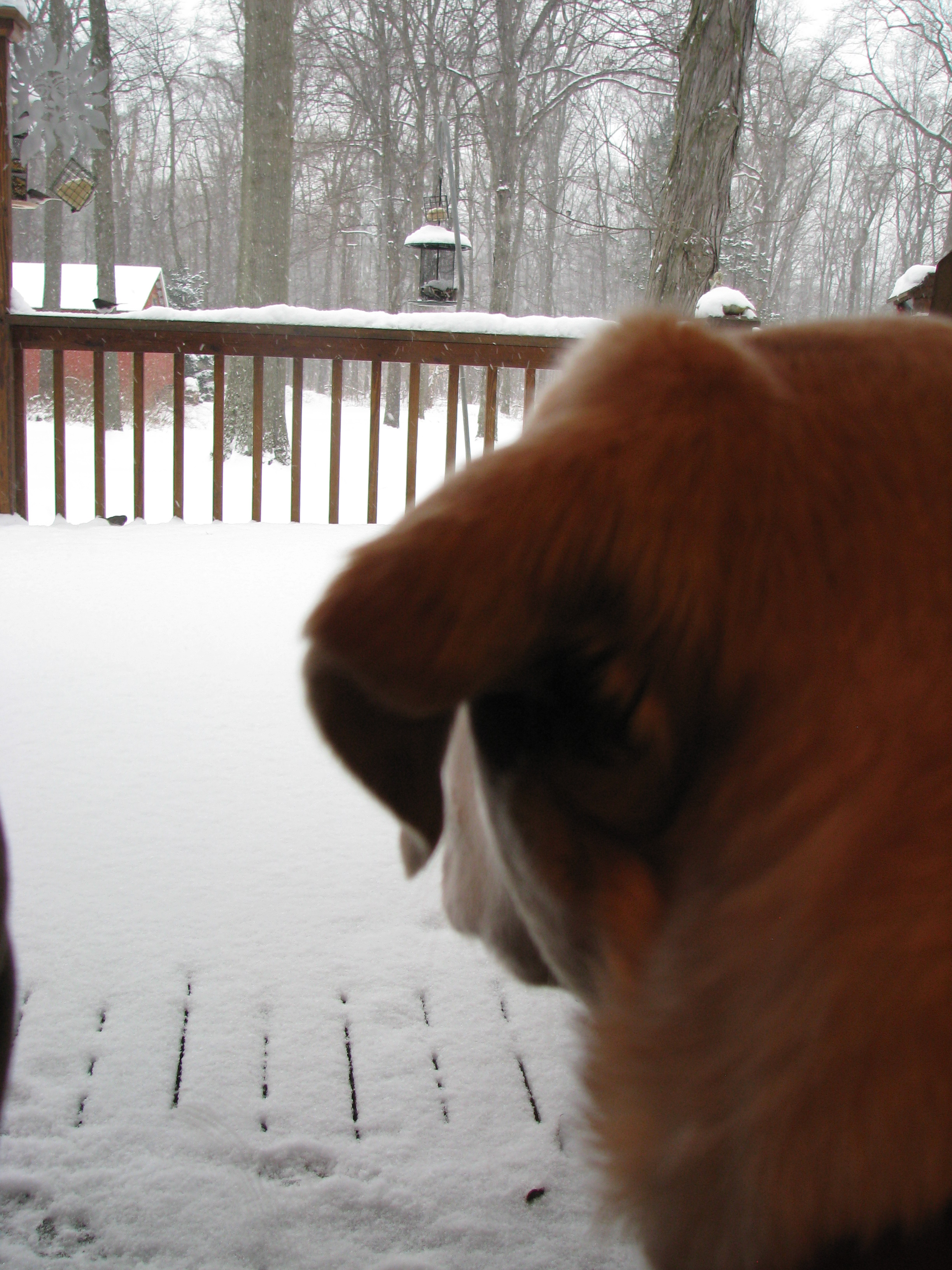
Bogie looking out across his domain
Ohio Winter

One winter Saturday, one of those cold Ohio days in late December or early January, my dad reads an article in the Akron Beacon Journal about bald eagles in Cuyahoga Valley National Park. We decide to find ourselves an eagle, an excuse to go outdoors. You need a purpose to go out in the winter in Ohio, there’s no going outside just for the sake of being outside. Without a reason, or once the reason is forgotten, the frigid bleakness soon saps your body heat and spirit, and ice starts to form in your veins.

We bundle up, Dad and my younger brother in their winter Carhartt jackets, dirty from splitting and stacking wood in the backyard. I wear my ski jacket, the one I got in high school when I learned to ski at Boston Mills. We grab our wool hats and binoculars, jump in the truck, and take the long way through the Valley to Ira Trailhead, one of our usual starting points along the Ohio and Erie Canal Towpath Trail. There is one other car in the parking lot.

On the trail we head south and within five minutes we see our first bald eagle, perched on a bare branch over the Cuyahoga River. The water is brown and sluggish-looking, the white foam along the edges frozen. After a few minutes of passing the two pairs of binoculars between the three of us the eagle flies away, heading downstream. We decide to continue on, to give chase. Bald eagles aren’t uncommon here, but we don’t always see one when we come. We’ve never seen one, let alone two, in such a short amount of time. I follow in Dad’s tracks, stepping in each footprint like I did when I was little, only now I can match his stride and our feet are nearly the same size.

Another five minutes and we find another eagle, probably the same one. It’s found a companion, and the two sit in adjacent trees, silently staring out at the world. When they eventually decide to fly away they head away from the river and the Towpath. We retrace our steps back to the promised warmth of the truck, walking along someone’s cross-country ski tracks. The muted sun is on its way down. We can barely see our breath in the dusk.

At home, we eat pizza in the family room, watching television. There is a fire in the wood stove and the pets gravitate towards the warmth, lying on the hardwood floor almost touching the stove itself. We linger on the couch, no one wanting to leave for colder beds. The snow is falling softly outside, turning the track-filled yard to a clean slate, a sparkling white canvas where the deer and songbirds will write their stories.

Right now there is nothing to see through the dark windows; they’ve turned to mirrors, reflecting the firelight and TV light, reflecting us on the couch sitting together on a cold winter night in Ohio.

Animals on the Refuge

Though you might not realize it from reading my blog, there are in fact other animals at Carolina Sandhills in addition to red-cockaded woodpeckers. Here are a few pictures of some of them and fellow intern Whitney’s arms. There may be a full-body shot in there somewhere too.

We found a turtle! This is a male yellow-bellied slider. Male because it’s flat on the bottom (in fancy terms his plastron is slightly concave). The theory is that this helps the males to climb on top of the females when they breed.

I like the shadow of Whitney’s hands and the turtle on the ground.

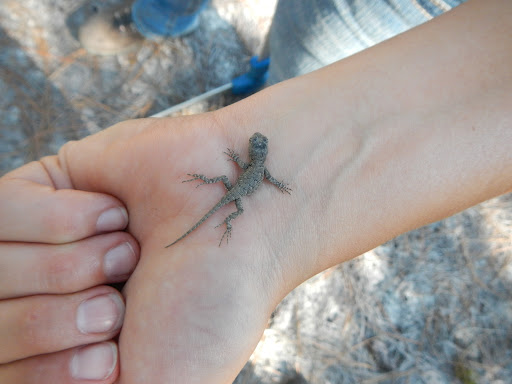
We found a small tiny lizard that tried to climb Whitney’s pant leg during one of our vegetation surveys.  Our best guess is eastern fence lizard. Whatever it is, it’s cute.

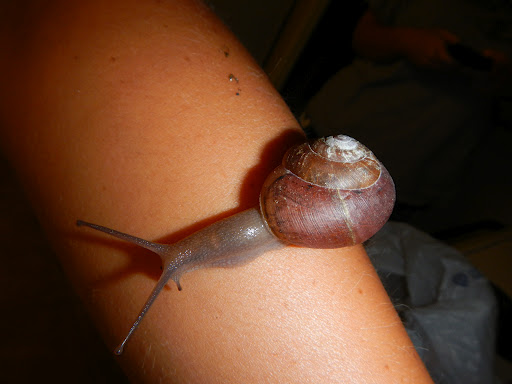
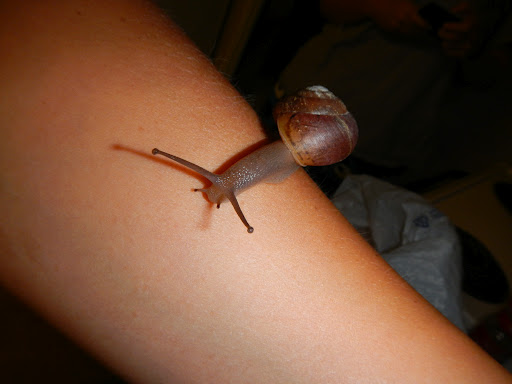
Whitney found a land snail and brought it in the kitchen! She was outside the bunkhouse one evening making a phone call, and found this dude on the stoop. Actually, this snail might be a dudette, or both (many snails are hermaphrodites) so let’s just stick with “dude.”

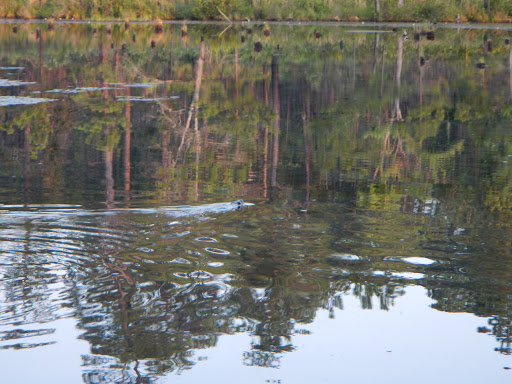
One afternoon as we were driving back to the office, we saw a dark shape lumbering down Wildlife Drive. We first thought it might be a raccoon, but as we got closer we realized it was a beaver. We stopped the truck a respectable distance away, got out, and took some pictures. Instead of staying away from us, the beaver strolled right up, crossed the road in front of the tuck, and trundled along just a few feet away from where Whitney was crouched taking pictures. It then crossed back over the road and headed into the pond.

Close encounters of the beaver kind.

The Beaver Song, which I learned from Chris at Aullwood Audubon Center and Farm. There are also hand motions, which I’d be more than happy to show you sometime. I only remember the chorus, which is a call and response.

Long tail (Long tail)
Big buck teeth (Big buck teeth)
Swimmin in the water (Swimmin in the water)
Chewing on trees (Chewing on trees)
Building up a dam (Building up a dam)
You know who I am (You know who I am)
I’m a Beaver, I’m a Beaver, I’m a Beaver! (I’m a Beaver. I’m a Beaver. I’m a Beaver!)

Swimming away, looking for trees to gnaw on.

Beavers can weigh up to 60lbs, and can be 23 to 39 inches long, excluding the tail, which adds an additional 8 to 12 inches. Not something you typically expect to see trucking down a paved road in the middle of the afternoon, especially as beavers are usually nocturnal.

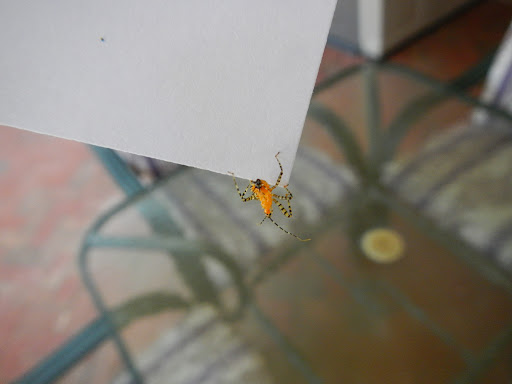
And these pictures don’t have Whitney in them (and therefore are not nearly as interesting) but I did find this really neat insect while I was cleaning my peeper– the telescoping camera we use to look in woodpecker cavities. Not sure what it is, but it’s cool!

The Last RCW Banding

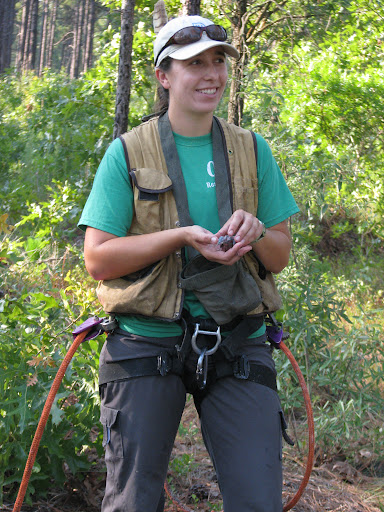
Friday was the last RCW banding of the 2012 season. It’s been a busy few months, and while it is nice to not be as busy (especially in this heat!) I am sad that there are no more trees to climb and ugly baby woodpeckers to play with. My time here at Carolina Sandhills is almost up, and it’s been fantastic. I am exceptionally glad I took this internship and was able to spend 12 weeks here working with RCW’s. Birds are always fun, and climbing trees is awesome, but I think the best part of this internship has been all the people I’ve been privileged to work with. While I’m not always excited about getting up early or having to tromp through the chigger/horse fly/ poison oak infested forest to look for cavity trees, every day is still fun because of the people here. I’m not sure where the future will take me after I leave this place, but I’ll never forget the experiences and people. Especially Brady Vaassen, fellow intern and one of my housemates, who is sitting here on the couch next to me asking when I’ll write a blog post about him and trying to get me to move so he can have the entire couch. Just because you’re 6ft 5in and a bit doesn’t mean you always get to hog the couch.

Pictures were taken by the fabulous Whitney Wallet, intern extraordinaire and friend of the first class.
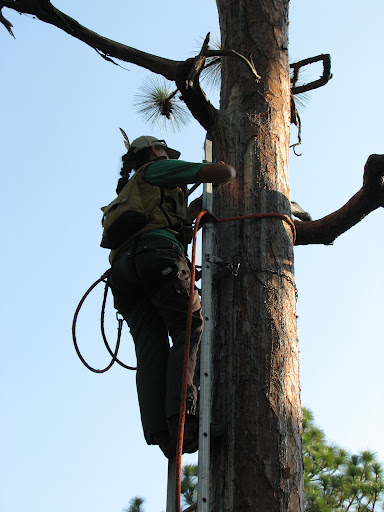
20ft up a longleaf pine at a RCW cavity. And yes, I do have a turkey feather stuck in my hair.
Trying to get the nestling out of the cavity with my noose.
Nestling secured in the bag slung around my back, and heading down to the ground to get it banded.
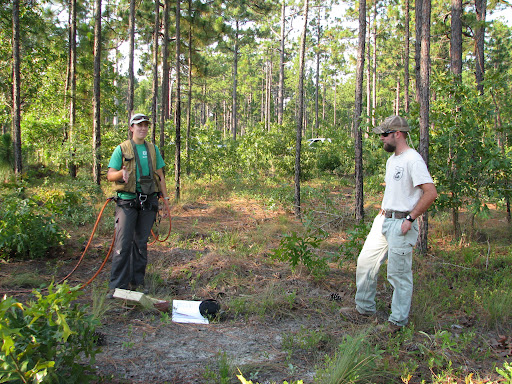
Getting ready to band (or standing around looking important).  That’s Evan Brashier on the right (not an intern, he actually gets paid), he banded the chick since I got to climb up and noose it.
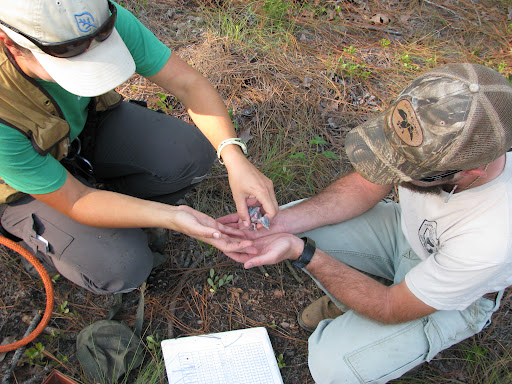
Chick in hand, I make my stand, ready to band, best in the land.
The passing of the RCW chick.
Evan banding the chick. It was about 9 or10 days old.
Climbing back up to put the newly-banded nestling back home.
I don’t normally get this excited about putting nestlings back, but there were some interesting comments coming from the peanut gallery on the ground (aka Whitney and Evan).

A Blue Jay Tale

by Lauren Smith
pictures by Meghan Oberkircher


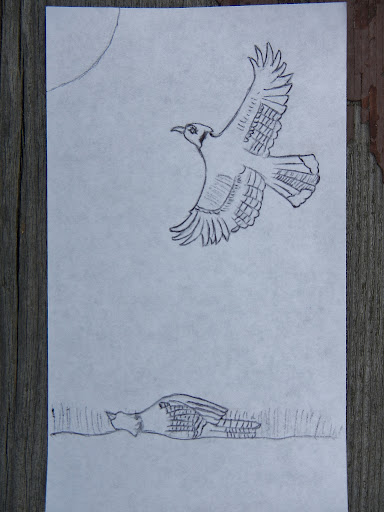
Once upon a time there was a baby blue jay who, when he was very small, decided he wanted to become an adventurer and explore the world. Unfortunately he decided this before he could fly (and before he really had any feathers) so he didn’t get very far.


A hog-nosed bat named Batrick (Bat-Bat to his friends) flew by on his nightly foraging foray and, seeing the poor little blue jay shivering on the ground, decided to take it home to his bat cave.


The little jay, with little thought for his probably slightly worried parents, climbed on board Bat-Bat’s back for the journey to Bat-Bat’s bat cave.


Bat-Bat’s mother was not exactly pleased about another mouth to feed but she let Bat-Bat, her only son, keep his new foundling. Bat-Bat didn’t have too many friends, so his mom didn’t have the heart to deny him this new companion.


The year went on and the little jay grew into a grown-up normal-sized jay. The jay, who they did name (but as bats only communicate with high-pitched squeaks, no one but Bat-Bat and his mom knew what the jay’s name actually was) learned how to live like a bat. He roosted upside-down during the day with Bat-Bat and his mom, and ventured outside at night to eat copious amounts of insects.


One night, while chasing a succulently juicy moth, the jay became so single-minded he forgot to watch for predators. The jay, since he didn’t know how to echolocate and didn’t have the greatest night vision, was usually pretty bad at catching enough food to eat. This night he was particularly hungry, so his owl-dar was down.


Owls and blue jays tend not to get along, and this encounter did not end well for our blue jay friend.


Lucky for him, the next morning an attractive female blue jay named Mary Jayne flew by while taking her morning constitutional. Mary Jayne was an exceptionally observant jay and it only took her 20 minutes to notice our poor jay friend laying on the ground, gasping for air.


Mary Jayne decided that she needed to nurse the poor wounded jay back to health.


Mary Jayne had never nursed anyone back to health before so she wasn’t really sure how it worked. She decided to take the wounded jay to an old red-cockaded woodpecker cavity in a longleaf pine tree so he could heal in privacy. Al of the sap adhering to his wounds helped them to heal quickly, though the jay pretended he was still weak so that Mary Jayne would continue to feed him mouth-to-mouth. 


Since they were on such intimate terms, they decided the jay needed a name. After much deliberation, they arrived at Elmer. Both agreed that Elmer was a fine, strong name for a blue jay. 


The newly christened Elmer Jay took Mary Jayne back to the bat cave to meet Bat-Bat and his mom. They, unlike Elmer’s jay parents, were actually worried when he disappeared and had spent many nights searching for him. 


Bat-Bat and his mom were overjoyed that Elmer had returned and was all in one piece. They were so happy to see Elmer and Mary Jayne that they broke into a spontaneous dance, which most bats reserve only for truly special occasions. 


Naturally, Elmer and Mary Jayne hooked up, and after a year or so started having little baby jays of their own. They were very good parents, and never let any of their offspring get stolen away by bats. 


Bat-Bat also eventually found a female friend and they too procreated, producing a cute little son named Batrick Jr. 


The Bats and Jays remained close and their children frequently had sleepovers. Even tough the Jays decided to go diurnal, they did decide that roosting upside-down was a much preferable sleeping method. 


Both the Bats and the Jays went on to live long, fulfilling lives, full of joy and happiness. 


The End


For an article on upside-down roosting blue jays, see: 
http://pispbirdbanding.blogspot.com/2011/09/new-study-shows-blue-jays-roost-upside.html

Climbing Obed

“Yet what struck me all at once was how breath-taking and bizarre climbing was. You could never stay bored: the risk alone keeps your synapses jangling. It was not simply that most non-climbers would be freaked out of their minds to find themselves where I was standing on the edges of my big toes 150 feet off the ground. It was that there was something special about the sport, some intricacy of deed that takes hold of the spirit and asks it fundamental questions. All climbers are ambivalent about climbing; yet we all find it hard to quit, and it is impossible to forget the surpassing joy of our good days in the mountains.”
~David Roberts, from Moments of Doubt
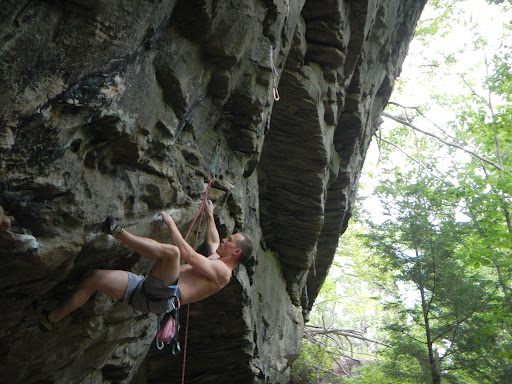
This past weekend I met up with two friends, Lucas and Blake, and went climbing at a place called Obed Wild and Scenic River, which is in Tennessee. It is an amazing place, with lots of rocks, brilliant green plants and trees, and winding rivers and stream beds. There are lots of things to do there other than climbing, not that I partook. I hope I can go back sometime soon and spend more time in the area (and climb some more rocks!)
I hadn’t climbed since just before Christmas, so my climbing muscles had gotten much wimpier than I liked (or pretended they were. In my head I can climb all day with arms of steel). Turns out that if you want to climb spending the winter in Florida is not the best place to be.  Go figure. So when I had the chance to go climbing in Tennessee, I jumped in the car and rode like the wind (if the wind goes a consistent 65 mph down the highway). I spent Saturday and Sunday at Obed, mostly just hanging out and watching Blake and Lucas, but I had a wonderful time. It was so nice to be around climbers again, people who use words like “crimpers,” “slopers,” “red-point,” “pumped” in pretty much any conversation, and spend inordinate amounts of time discussing climbing shoes, ropes, and routes. I haven’t been around serious climbers in a long time, so it was fun to be immersed in the climbing jargon again. I felt like I was in another universe, one that I’d been away from for too long. It was great.
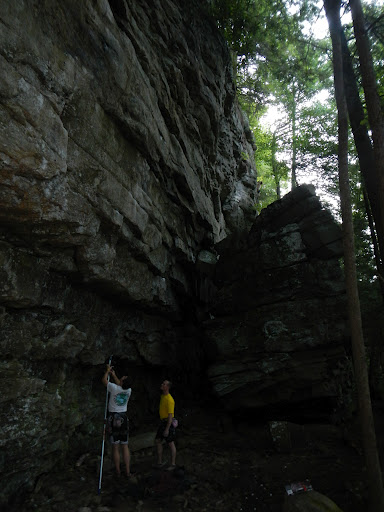
Blake and Lucas getting ready to climb.
Lucas climbing.
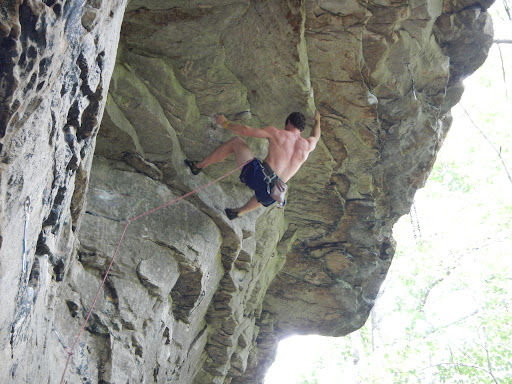
One of the areas where we climbed. All of these routes were too hard for me, so I just took pictures and belayed.
Blake, almost at the end of the climbing route (the edge of the overhang).
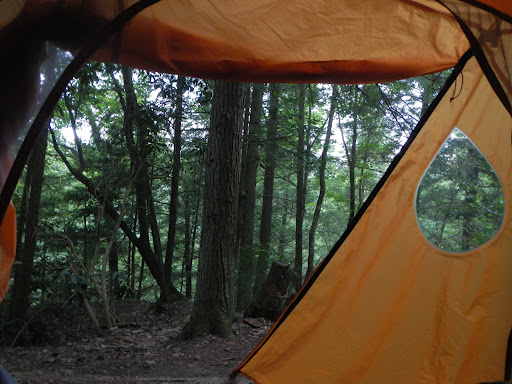
The view from my tent.
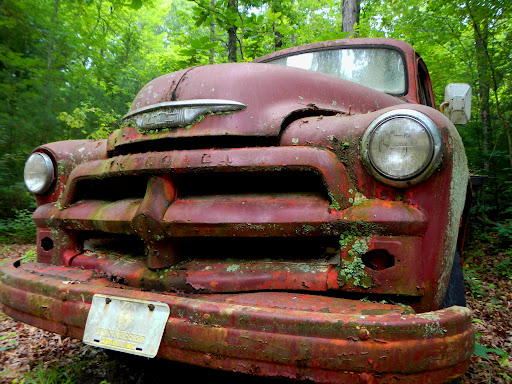
Neat old truck at the campsite.
A cute dog from a nearby campsite that helped me pack up my tent  and then played fetch with me. Afterwards he decided we were inseparable and jumped right in the front seat of my car. He was ready to go back to South Carolina, though he maybe wouldn’t have been so eager had he known about the 6 hour drive.
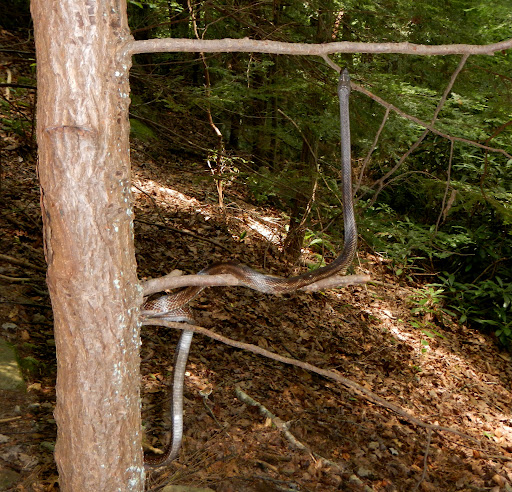
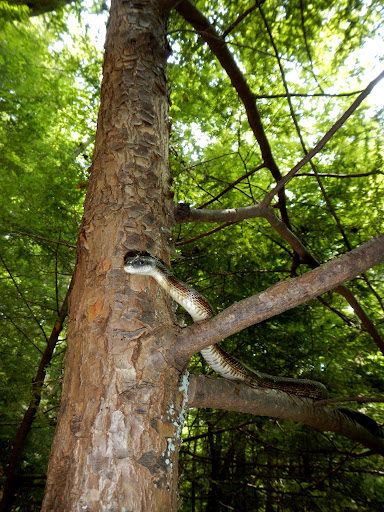
I wish I could climb trees like this snake can, it would make climbing trees to band RCW chicks much easier!
Why hello up there Mr. Snake.

I had a fantastic time climbing this past weekend, and hopefully it won’t be another five months before I can climb again!

More RCW Banding

The red-cockaded woodpecker nesting season is dying down, and all the babies are starting to fly away. Here are some pictures, taken by myself, fellow intern Ashley and high school intern Katie, of the climbing/banding process.

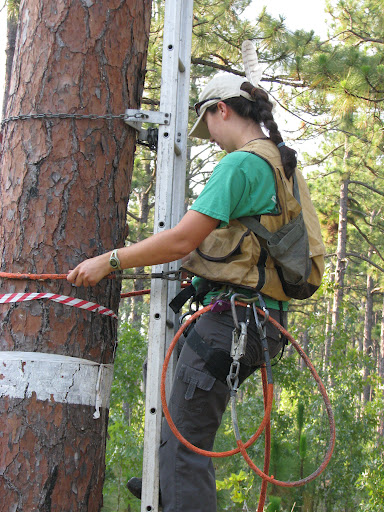
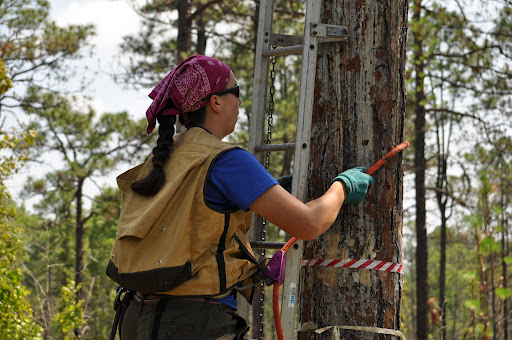
Here I am starting to climb up the tree. I’ll go up another rung to where I can reach the bracket (just above my head on the ladder, against the tree) and then I’ll wrap a chain around the tree to secure the ladder. The ladders are in 10ft and 5ft segments, and have tongues on the ends to attach them together to whatever height we need. The highest I’ve ever had to climb was 30ft, or 3 10ft ladders.
At the cavity, getting ready to remove the chicks. The rubber tubing is my noose, which I stick in the cavity and use to grab the nestlings.

Hanging out 30ft above the ground. The view is generally pretty nice from up there.

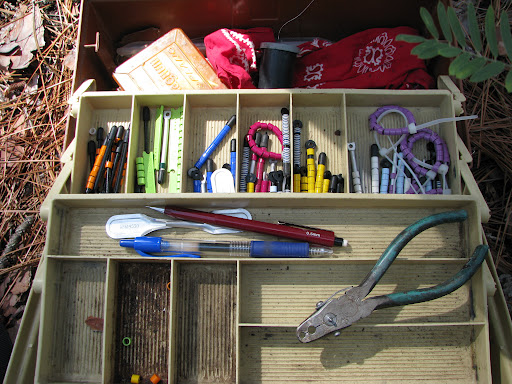
Our banding kit. We put aluminum bands with unique numbers on each nestling, and also a unique combination of colored plastic bands. This is so we can later identify the birds without having to catch them again to read the tiny numbers on their legs. With binoculars or a spotting scope, you can sometimes (if the birds cooperate and permit you a good view of their legs) read the color combination.

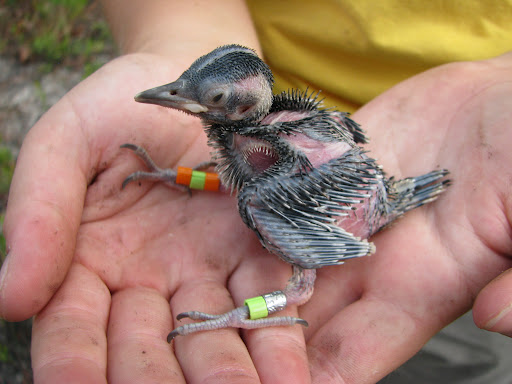
This nestling has color bands yellow/white/yellow on its left leg, and an aluminum band/light green (which you can’t really see in this picture) on its right.

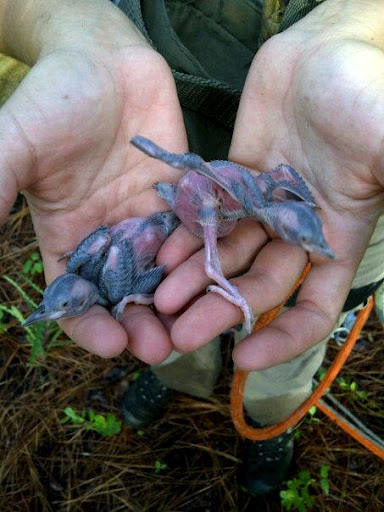
Two RCW nestlings, about 9 or 10 days old. Their eyes have just opened, and their feathers are starting to poke out along their wings and tails. The one on the right was feisty, and liked showing off his legs.

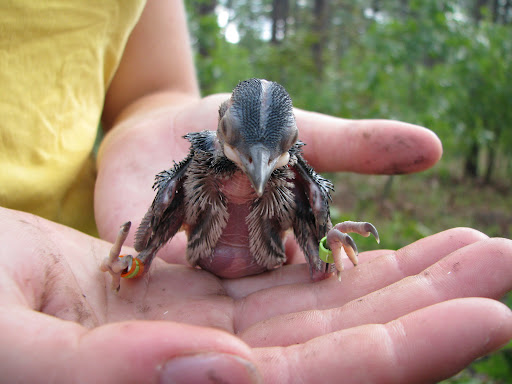
This chick was old, probably 11 or 12 days old. We generally try to band them between 7 and 11 days old, because they don’t have so many feathers for us to accidentally pull out. Also, it’s generally easier to get them before their eyes are open, because they’re not quite as aware of what’s going on and can’t see the noose and try to get out of the way.

Right leg: orange/light green/orange.
Left leg: aluminum/light green.

I like banding older chicks because their legs are bigger and it’s easier to get all the bands on, but, being older, they’ve figured out how to use all their body parts and with more actively struggle. This guy here has mastered his feet, and would grab our fingers. The younger birds, especially before their eyes are open, can barely stay upright in your hand.

Since most of our birds have finished nesting (we have about 128 nests) we are now starting our early morning cluster checks. This means we station ourselves by trees we think may be active (which means the woodpeckers are using them) before sunrise and wait to see if any RCW’s come out. We do this to see if the cluster has a potential breeding pair which just didn’t nest. Typically the birds will come out and then chat a little with their mate, who roosts in a different cavity, before heading out to look for breakfast. The real fun part (other than getting up at 5 a.m. to be in the woods before sunrise) is then following them around for an hour or so, to see if they lead us to nestlings or a new nesting cavity. We have spotting scopes (telescopes on tripods) that we use to see the colored bands, and we carry those around with us as we traipse around after the birds. It’s not too bad, if you don’t mind waking up really early and then chasing after birds in the woods. Which I don’t. Birds are one of the only things I’ll wake up before sunrise for. The others are traveling and rock climbing. Sometimes.

I like the mountains

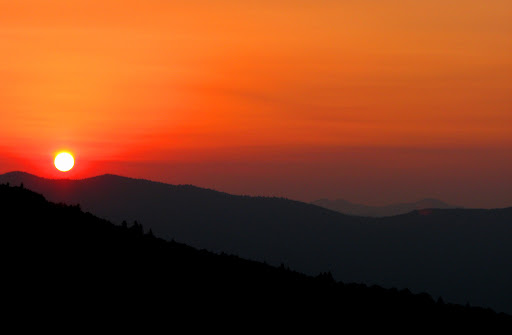
I like watching the cloud shadows move across the mountains. I like seeing only mountains for hundreds of miles in all directions. I like the baking sun and the cooling wind, making me cold and hot alternating. I like this rock that I sit on, an exposed bit of mountain skeleton, rough beneath my arms and legs.

I like listening to the birds; towhees, warblers, thrushes, claiming their own small section of the world. I like that I can hear waterfalls, hidden in the valley crevice somewhere before me. I like the ravens riding the air, circling and diving. I like imagining what it would be like to leap from this rock to join them, soaring from one mountain to the next, a scrap of dark dancing in the sky.

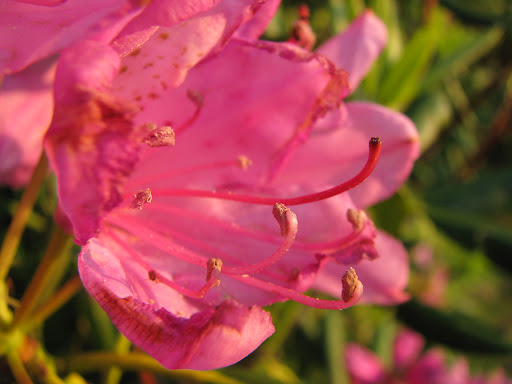
I like the blooming rhododendron, their fuchsia flowers beacons of color in the verdant undulations of mountain. I like the flies that look like bees, gently probing the sweat on my arm. I like sitting here, silent, knowing that all is right with the world.

I like how as soon as I step out of my car I feel again that joyful peace of the mountains. I like knowing that whenever I come back all this will be here. The rock and the birds and the flies and the sun and the water and the wind will never leave this place. I like that even when I leave I take the essence of this place with me in my soul.

My heart belongs to the desert

My heart belongs to the desert; land of sun, dirt, rock.
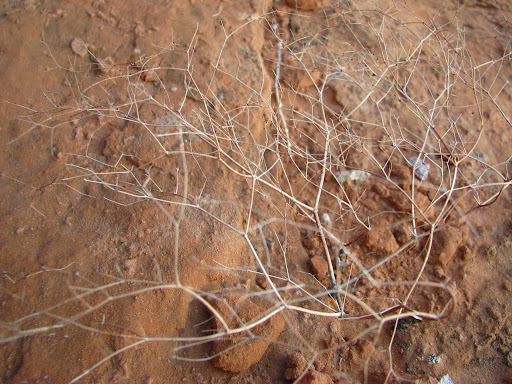
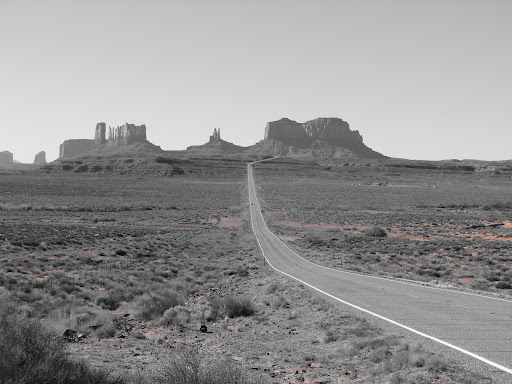
I am the raven, dark shadow on the red rock wall. I am the sage, slowly crinkling in the sun. I am the rock pinnacle, rising out of the flat. I am the sun, browning rows of fence. I am the road, pavement stretching on into the horizon. I am the hawk on the fence post, waiting. I am the jackrabbit, listening. I am the bone-thin horse, running. I am the wind, touching every grass, every particle of dust.  I am the hard-baked earth, cracked and parched.  I am the tree, twisted by life without. I am the beetle, crawling. I am the coyote, spilling secrets to the stars. I am the bright moon, giving light to those who cannot see. I am the traveler, sleeping in the night-cold, peaceful.
I am the one standing on the rise, greeting the rising sun with my own spirit-light, the light within merging with the light without.
All pictures were taken in Utah (2011) during a road trip taken with my friend Max from Ohio to Colorado, via all sorts of interesting places like the Red River Gorge in Kentucky, New Orleans, the freeway system of Texas (not really), New Mexico, and Utah. This piece was written during that same trip. 

Kalmia Gardens

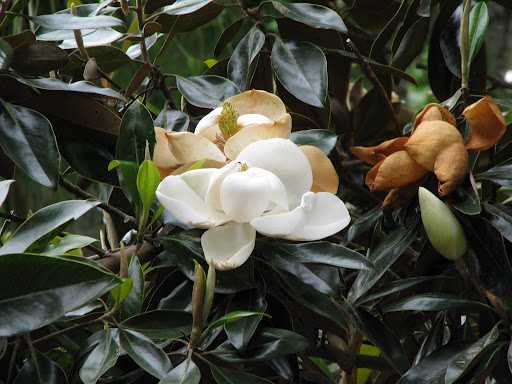
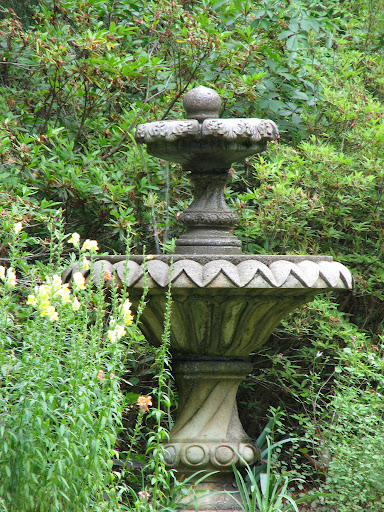
Yesterday I journeyed to a beautiful quiet part of Hartsville called Kalmia Gardens. I’d driven past it a few times on my way into town for supplies (conveniently, it’s just down the street from Bi-Lo, the local grocery store). After driving past the intricately wrought gates a few times, I knew I had to explore. The drive into the gardens is narrow and easy to miss, hidden behind dense foliage. As with many truly beautiful things, one needs to look deeper in order to see.
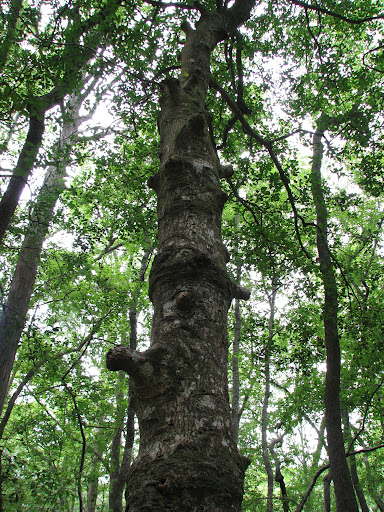
Kalmia Gardens are quite unlike Carolina Sandhills. Here we have pines, tall and open, the soil sandy and covered with a thick layer of browned needles. The gardens are another place entirely, reminding me strongly of the tropics. Thick layers all around, the sunlight filtered through dark green leaves, vines holding all the trees together, growing over and in and on top of everything.
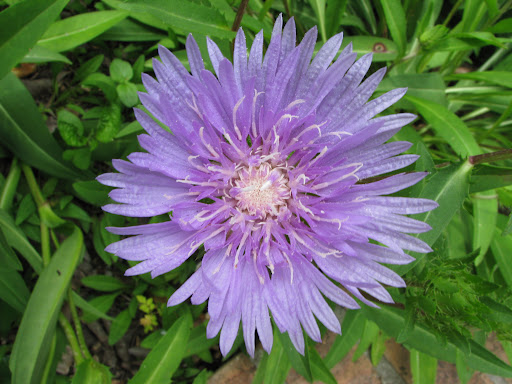
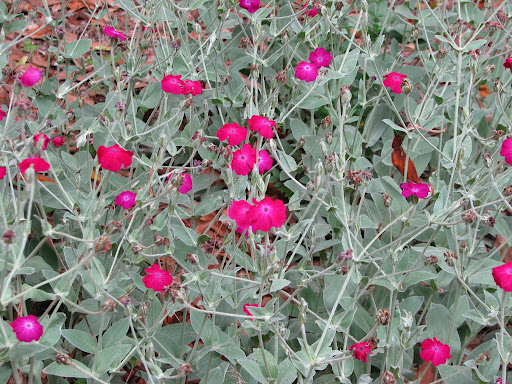
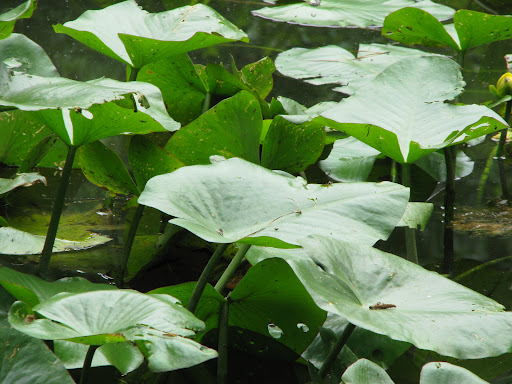
There is also water here, streams, rivers, the soil is dark with water. With water comes lush life, bursts of colored flowers growing everywhere they can.
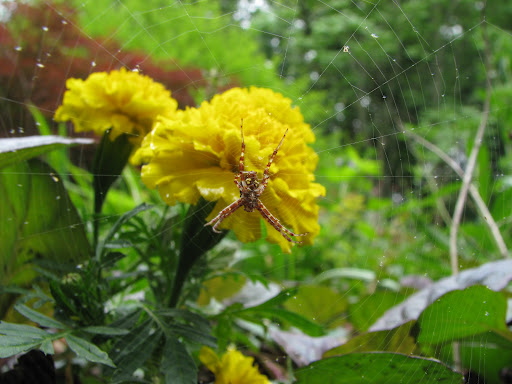
I’ve always liked marigolds, their scent and their sturdiness. Their yellow petals remind me of the ruffles on a dress of a little girl, running in the bright sun after dandelion fluff, in her hair a yellow bow that perfectly matches the ruffles on her dress and tiny socks. The brightness of her joy hides any grass stains on her knees and skirt, the dirt on her face disappearing as she grins and shrieks with happiness.
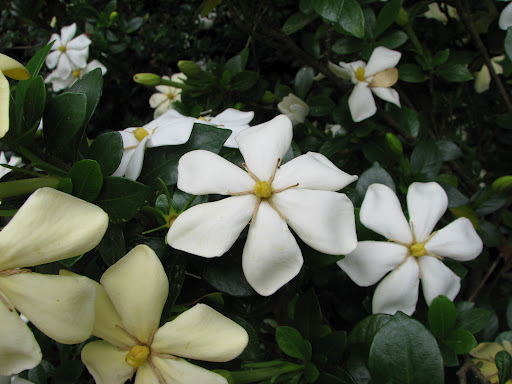
The gardens have a slightly disorderly feel to them, which I love. In a place like Kalmia Gardens, one can imagine the spirits of the plants, wood sprites and water nymphs, peering from behind the lilies or having a merry picnic on the banks of the pond, cavorting and singing with the robins. The wrens, nimble in the mountain laurel, let loose a tumble of liquid sound before diving away into the shadows, perhaps to find a meal for their young in the nest.
If you’re interested in the history of the gardens, there is the Kalmia gardens website: http://www.kalmiagardens.org
Happy Mother’s Day Mom!
Every flower I see reminds me of you and all of the wonderful ways you have made my life beautiful. Thank you for showing me the beauty in every living thing, and for teaching me how to properly dead-head. Without you, my marigold-self would be scraggly, with all sorts of ugly bits hanging here and there. Thanks for keeping me dead-headed and helping me to grown into myself.
I love you Mommy! You’re the best Mom I’ve ever had 🙂