Nest Searching: The Good, The Bad, and The Ugly

Nest Searching

When we’re not banding birds, we’re searching out bird nests and monitoring them. This means that, at three of our banding sites, we also look for nests. We’re targeting four species of birds: Yellow Warblers, Black-headed Grosbeaks, American Robins, and Song Sparrows.

Why do we do this? Well, we’re interested in the productivity of the birds– how many babies are they having, and are those babies fledging, or surviving long enough to leave the nest. One of our research aims is to study as much as we can about the survivorship and productivity of the birds in the area, since birds are an excellent indicator species. What is an indicator species you ask? Something like the indicator light on your car, actually. Birds are highly sensitive to changes in their environment, so if the birds are disappearing it can mean something is up with the ecosystem. The causes of their disappearance can be as mysterious as the reasons for the check engine light to come on, but with greater consequences for the world (see “Silence of the Songbirds” by Bridget Stutchbury).
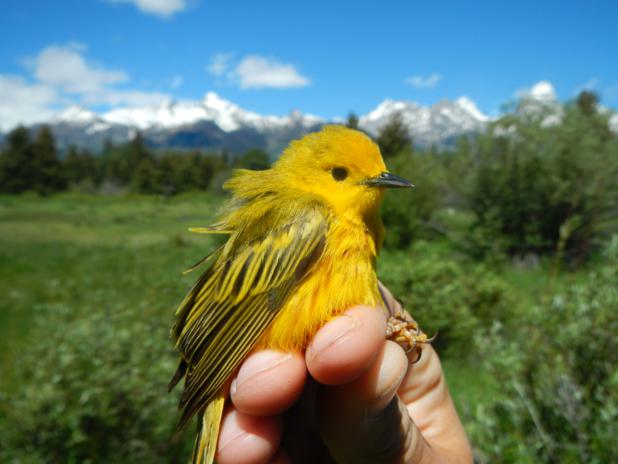
Up close and personal with a beautiful male Yellow Warbler. His feathers are a little ruffled because of the wind. And yes, those are the Tetons in the background.

Up close and personal with a beautiful male Yellow Warbler. His feathers are a little ruffled because of the wind. And yes, those are the Tetons in the background.

We banders are busy people, setting up mist nets and banding birds for six hours every day, so we have lovely crews of Earthwatch volunteers assist us with nest searching. Earthwatch is an organization that organizes groups of volunteers from around the country to travel to different places around the world to participate in “scientific field research and education in order to promote the understanding and action necessary for a sustainable environment.” It’s a pretty cool group, and so far all of the volunteers we’ve had come visit have been absolutely outstanding.

Here’s their website, if you’d like any additional information: Earthwatch. If you want more about the Earthwatch Expedition that deals specifically with our work here in the Tetons, then check out this link: Spotting Songbirds in the Rockies 2013.

Every week the volunteers search for nests, and then we banders are in charge of monitoring those nests, or nest checking, twice a week (on Mondays and Thursdays). Usually this takes place after we are done banding for the day, and we’ll divide and conquer to check the nests at all three sites in a reasonable amount of time.  Sometimes, despite our best efforts, it still takes a long time. Bird nests are not always easy to find. When a nest is found, we take a GPS coordinate, compass bearing, and also fill out a nest card, with a hand-drawn map and written description on the back. Despite this, some nests can be extremely hard to find. (See The Bad, below).

The good

Finding nests, and having the baby birds fledge successfully. Watching them flop around in the bushes, learning how to fly, can be quite amusing.
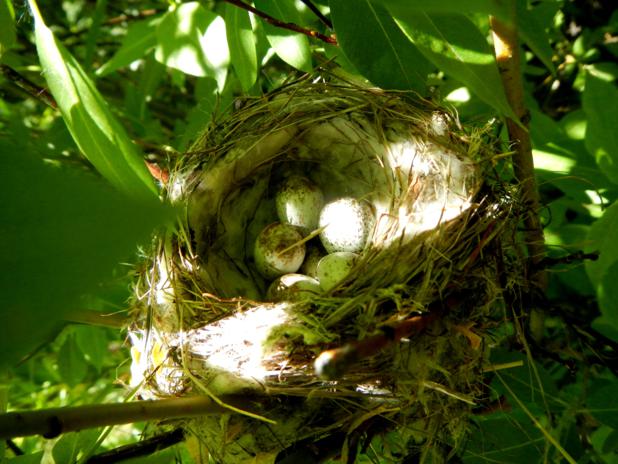
Yellow warbler nest

A yellow warbler nest with five eggs. To make a nest, a female yellow warbler makes a cup of grasses, bark strips, and other thicker plants, and then lines it with softer materials like animal hair, feathers, and plant fibers. Their nests are usually around 10 feet off the ground, though many that we monitor are not that high up.

The bad

Like I mentioned above, each nest has a nest card with written out directions and a hand-drawn map. I’m not going to mention any names here, but some people are really bad at giving directions. Like really bad. Sometimes I’m pretty sure trying to assemble a TV with only the Korean directions would be easier than trying to find some of these nests using the “directions:”

“Follow compass bearing 5 meters and you will see a pushpin that points to the nest.”

Moose at blacktail ponds

A female moose at Blacktail Ponds. She was not impressed with my thrashing through the willows looking for nests, disrupting her afternoon amble. She posed for a minute, and then slipped away into the willows. For such giant creatures, moose can be surprisingly swift and sneaky. I didn’t see her again.

Right. You try looking for a pushpin in a willow bush, with a “map” that consists of two willow clumps and an arrow pointing to the middle of one of them. I’m standing in a thicket of willows here, surrounded by dense undergrowth, and there are five different willow clumps along the bearing. This is habitat where moose disappear. Eight-hundred pound, six foot tall moose. Hundreds of tourists come here everyday looking for wildlife and they can’t find moose in this habitat, while you expect me to find a pushpin. “Look in the direction of the Grand Teton, and you’ll find a moose.”

How high up is this push pin? What color is it? Is it to the right or left of this cottonwood tree you could have used as a landmark? Do I have to cross this stream, which you also could have used as a landmark?

The fact that we usually don’t start nest checking until after we’ve banded for 8 hours probably doesn’t help much either (my morning coffee has definitely worn off by then). Or the fact that it’s hot, and by that point the mosquitoes have made themselves known. In an attempt to find one particularly frustrating nest, I found a cedar waxing and then a gray catbird nest before I found the black-headed grosbeak nest on the card. At least I knew it wasn’t that I had suddenly lost my ability to locate bird nests.

On the whole, though, most of the nest cards give very good directions, and make it fairly easy to find the nests. There are only a few particularly memorable bad nest cards that make me want to pull out my hair and scream. Which isn’t such a bad thing, the screaming at least, because it lets the moose and bears know where we are so we can’t accidentally surprise them. Which is not something I’d recommend.

Song Sparrow nest

A song sparrow nest. Song sparrows are typically ground nesters, and the female does all the work to build the nest, though the male does help her pick the perfect spot. She makes it out of grass, and will line it with more grass and animal hair. Nests are 4-8 inches across, and 2.5-4 inches deep.
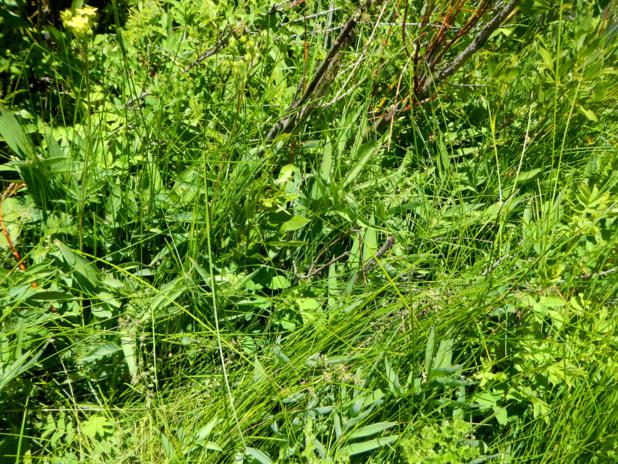
Can you spot the song sparrow nest? I thought not.

Can you spot the song sparrow nest? I thought not. It’s directly underneath the branch on the right, directly under a blue pushpin that you can’t see in this picture. Song sparrow nests are extremely difficult to find, and most are found through a combination of pure luck and many minutes of careful observation of the adults, to watch as they visit the nest.

The ugly

Baby birds are ugly. I don’t care what anyone says, these things are not cute, especially before their feathers grow in. After they are fully feathered, they’re much more attractive.
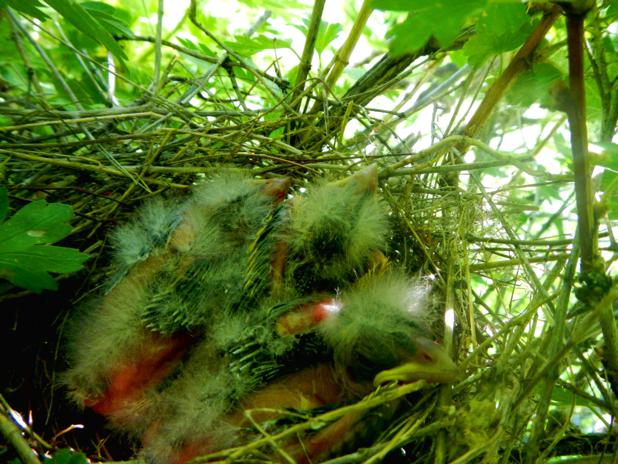
Black-headed Grosbeak nestlings, about 7 days old.

Black-headed Grosbeak nestlings, about 7 days old. And super ugly. Notice how the feathers on their backs and wings are in tubes, which are called pin feathers. These are their feathers growing in, and have a blood supply flowing through them. As the feathers grow longer, the blood supply will concentrate just in the base of the feather, and the bird will preen off the sheath so the feather can unfurl. Feathers are fascinating, and you can read more about them HERE.
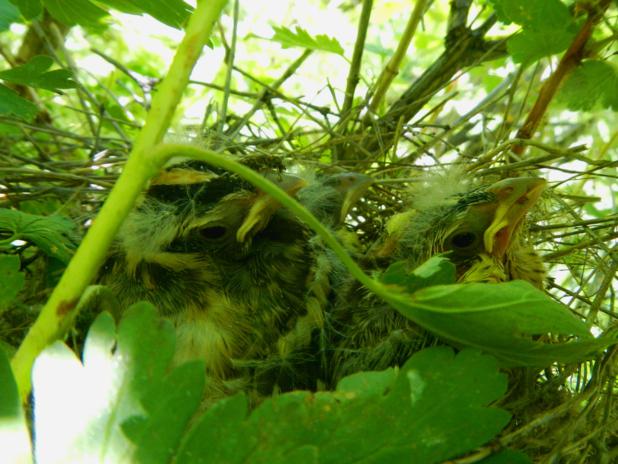
Black-headed Grosbeak nestlings at about day 12. Slightly cuter, but still pretty ugly.

The same black-headed grosbeak nestlings at about day 12. Slightly cuter, but still pretty ugly. Note their gapes, or the lighter corners to their mouths. This is a typical characteristic of baby birds. Gapes are usually brightly colored, and they inform the parent birds about the baby’s level of need, health, and competitiveness, which the parents use to decide who to feed first. The louder, more obnoxious nestlings get fed first, and more often, than the quiet ones. I probably would have starved if I was a baby bird. My siblings were not what one would call demure young children.

Now get out there and find some bird nests of your own to monitor!
Happy Birding!

Feathered Friday article

Guess who had a giant picture of their hands in the Jackson Hole News & Guide! Yes, that would be me. My hands are famous! I would even venture to say more famous than Sarah and Keegan’s faces, which are printed decidedly smaller, and also below the fold (We learned in Editing that whatever goes above the fold needs to be eye-catching, to entice readers to unfold the paper and read the article).

Feathered Friday article_464x618

This is important enough to have the place of honor up on the fridge. Which is really saying something, since we only have 3 magnets total. It shares a magnet with the Bunkhouse Rules, one of which is “If you don’t represent, don’t tell anyone you live in the bunkhouse.”

I mentioned in a previous post that we host Feathered Fridays once a week on the appropriate day. My parents and brother came to the one last week, and I had a fantastic time showing them what exactly it is I do when I go off to band birds (Grandma, I hope Mom showed you all the pictures, especially the one of the Red-naped Sapsucker clinging to Dad’s pant leg before flying off. That was pretty neat). All of the Feathered Fridays have been fun, so if you’re in the Jackson area and looking for something to do, come hang out with the bird banders! We’re all pretty awesome peeps, if I do say so myself. (Sorry, I couldn’t help myself.)

For a link to the Feathered Friday registration page, see my blog post What Is A Mist Net?

If you’re interested in reading the article, here’s a PDF version for your perusal:

JHNG_July3_2013

The good stuff (i.e. my hands holding an American Robin) are on the third page, but there is an interesting article about a roadkill study. The Teton Science School Conservation Research Center was contracted to do the GIS work for the study.

We’ve got all sorts of cool stuff going on here in Wyoming, so you should definitely come out for a visit and check out the bird banding and the roadkill. Or maybe just the bird banding.

See you at the banding station!


Fairies in our nets

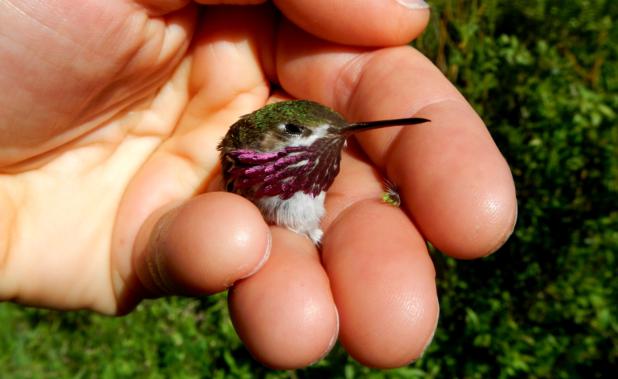
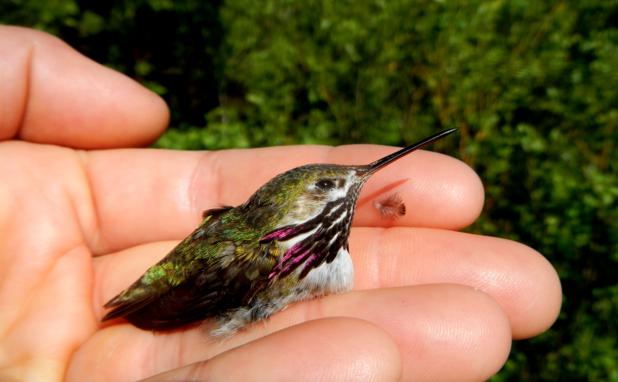
A male Calliope Hummingbird

A male Calliope Hummingbird.

Today we caught fairies in our nets– Calliope and Broad-tailed Hummingbirds. The male Calliopes have beautiful throats, an iridescent rosy or purple color, depending on the light. Sometimes, once I gently untangle them from the mist net, they’ll sit in my hand, miniscule feet tucked up into their chests, resting. Dark limitless eyes looking all around, diminutive breast heaving as if it had just run a marathon, their colors changing in the light– only an illusion, a change of perspective. After breath-holding seconds, when time seems to stand still, their wings begin their blurred-motion movement and they buzz out of my hand and back into their world.

There’s always a moment when I wish I could keep this tiny bird forever, but every fairy has to be free. How else do they keep their magic?

male caha in hand_618x379

The same male Calliope hummingbird, moments before he flew away out of my hand.

“Life is already too short to waste on speed.”

“Walking takes longer… than any other known form of locomotion except crawling.  Thus it stretches time and prolongs life.  Life is already too short to waste on speed.”

Edward Abbey

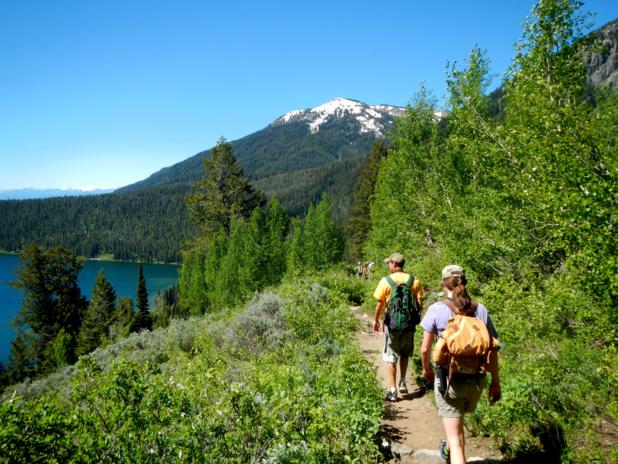
Hiking to Phelps Lake, on the trail to Devil's Canyon.

Hiking to Phelps Lake, on the trail to Death Canyon in Grand Teton National Park. That’s Keegan in front, and Stephanie behind him (there were seven of us total, the others were up around the bend). As the slowest hiker ever, I bring up the rear. And take pictures of everyone else hiking from behind.

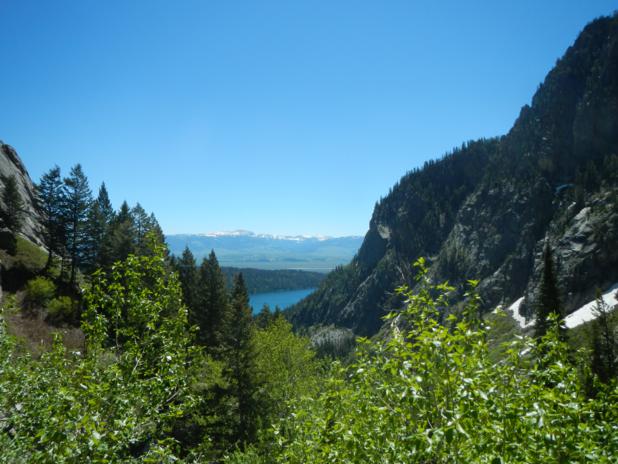
Looking back Devil's Canyon toward Phelps Lake.

Looking back Death Canyon toward Phelps Lake, which is probably named for Michael Phelps (I couldn’t find anything online that said otherwise, so that’s my theory). I’ll bet (though not any of my own money) he did all his training for the Olympics there. The water is freezing, it’d toughen you up real quick.

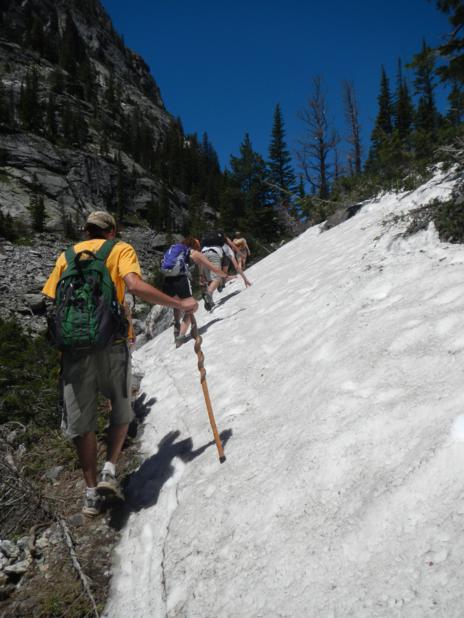
June 8th, and we're hiking through snow. Good thing  Keegan has that awesome walking staff.

June 8th, and we’re hiking through snow. Good thing Keegan has that awesome walking staff. We were all slightly jealous.

DSCN6181_1920x614

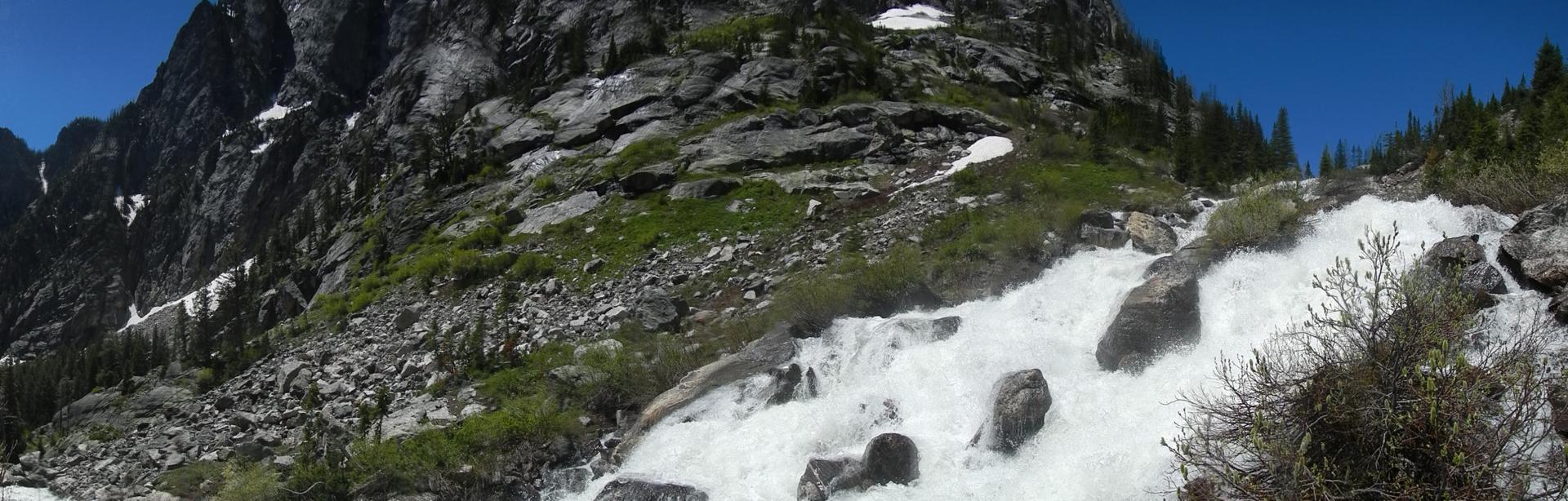
Death Canyon. No one died there, at least not from our party. Lots of wildlife, including a moose, quite a few birds, and a number of plants I couldn’t identify. All in all, a fantastic hike in Grand Teton National Park, and one I highly recommend to anyone. And any fellow life-enjoyers (aka those who hike slow) who would like a companion, let me know. We can meander and enjoy life to the fullest together while those other fast life-wasters hike on ahead and scare up all the bears and moose, which I’d prefer to observe from a distance anyway.

What is a mist net?

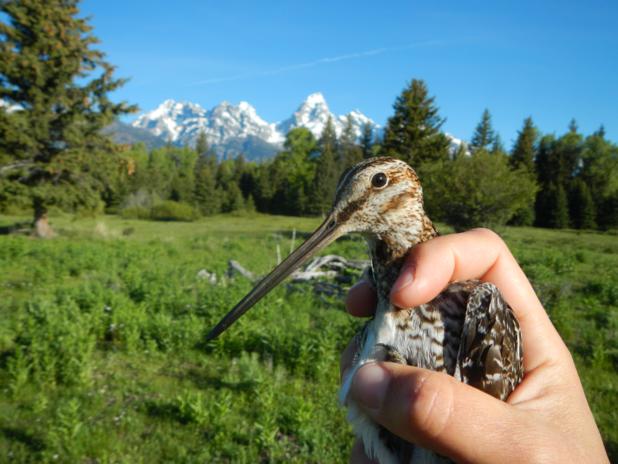
A Wilson's Snipe with the Teton Range in the background.

A Wilson’s Snipe with the Teton Range in the background. Snipe use those long bills to probe in the mud for food, like insects and other invertebrates (little squirmy things without backbones).

Sometimes when I tell people that I band (and therefore catch) birds, they get real quiet and look at me strangely. Do you use a fishing pole, a butterfly net? Cages? Hold out birdseed in your hand and wait for them to land, then use super-fast reflexes to grab them? I’m working on that last one, but no. We use these nifty thingies (a scientific term, by the way) called mist nets.

I handled my first mist net back in 2005 when I was a freshman in college (oh so long ago), so I’ve sorta forgotten that most people aren’t familiar with what one is. That’s the problem when you spend too much time hanging out with bird biologist types, you can use words like “mist net” and “trammel” and everyone knows what you’re talking about, and when you get jump-up-and-down excited about a Wilson’s Snipe or a Song Sparrow they’re right there jumping with you. Some people get into sports teams, I get excited about their bird namesakes. To each his own.

But before we get in too far:

Do not attempt this at home unless you are a trained professional.

And I mean it. You have to be registered with the government (USGS) to catch and band birds, which requires a license, research permit, and proper bird-handling training. The Migratory Bird Treaty Act makes it illegal to “take, possess, import, export, transport, sell, purchase, barter, or offer for sale, purchase, or barter, any migratory bird, or the parts, nests, or eggs of such a bird except under the terms of a valid permit issued pursuant to Federal regulations.” The term migratory bird here includes just about every native species, so basically: if you see a bird in the wild, leave it alone. To see a complete list of the species covered and for more information, click HERE.

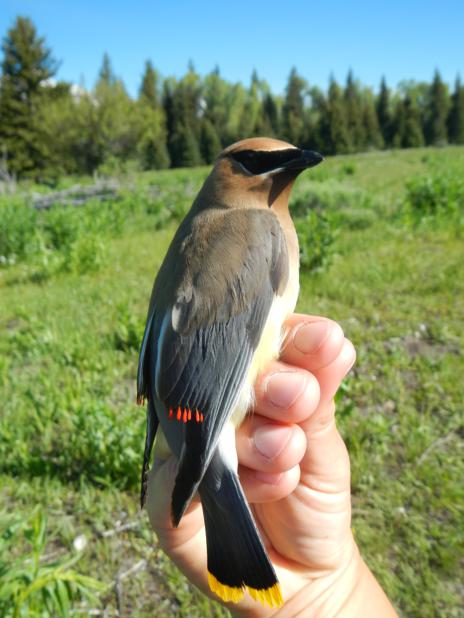
A Cedar Waxwing. Note the waxy tips on his wing feathers. No one knows exactly why some waxwings secrete these tips, but they sure do look cool (and maybe help attract the ladies).

A Cedar Waxwing. Note the red waxy tips on his wing feathers. No one knows exactly why some waxwings secrete these tips, but they sure do look cool (and maybe help attract the ladies).

We are trying to gather important information about bird populations, but first and foremost is bird safety. So if you ever come across a mist net with a bird in it, leave it alone. Don’t touch it. Someone will be coming along soon to safely get the bird out, I promise. Well-meaning passersby can seriously injure birds by touching them and trying to “help.” Would you go into a hospital, walk into surgery and start poking around in a patient? No, of course not. You need training to perform surgery– which is my point exactly.

If you’d like to read a 66 page document put out by the Ornithological Council entitled Guidelines To The Use of Wild Birds in Research, click HERE. The last page also details the American Birding Association’s Code of Ethics, which are a must-know for all birders and anyone interested in observing birds in the wild.

And now, after our brief safety interlude, on to the good stuff:

What Is A Mist Net?

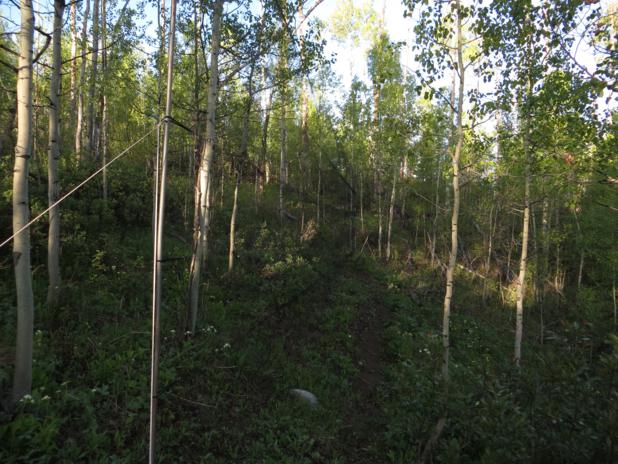
A mist net is a very fine net that we set up to catch birds. It looks like mist, and is a net, so we call them mist nets. Except they don’t actually look like mist. Imagine four 39.37 foot long hair nets (or 12 meters, since scientists reasonably use the metric system, unlike the rest of the US) strung between two poles, the bottom of the top one touching the next, and you have a fairly good idea of what a mist net looks like. Our nets are about 7-8 feet high, depending on how much we stretch them out, a guestimation based on the fact that we use 10 foot poles to string them on.

Picture borrowed from my co-bander Bo. Can you see the net stretching from the pole (going right)?

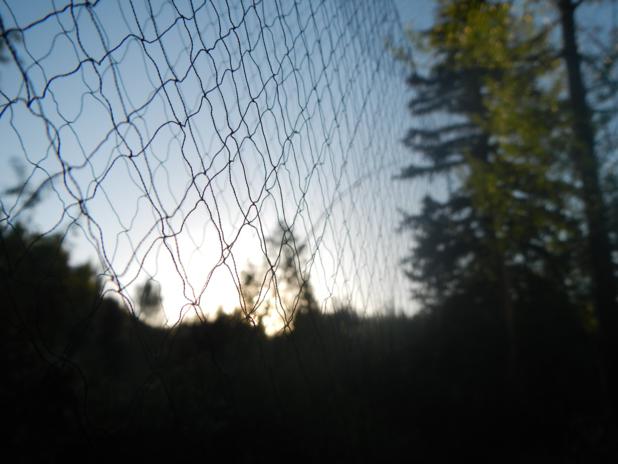
Picture borrowed from my co-bander Bo. Can you see the net stretching from the pole (going right)? It’s rather difficult to get a good picture of a mist net, since they are so fine and hard to see.

There are five thicker strings, called trammels, that have loops on either end and are what attach the net to the poles. Between the trammels stretch the mesh netting, which is fine enough that, once the net is spread open, is almost invisible (I’m guessing this is where the “mist” part of the name comes from). The netting forms a little bit of a pouch between each trammel, and when birds fly in they sometimes hit the net and fall into this pouch.

We use smaller-meshed netting (there are different sizes depending on what type of birds you are targeting; we’re trying to catch everything that will fly into the nets), and so larger birds usually don’t become too tangled in the mesh but instead are trapped in the pouch. Sometimes they can get themselves out before we get to them by flapping their way down the net until they get to the edge by the pole and then escaping.

The nets have give to them, so when birds fly into them they can bounce a bit, somewhat like the safety net below acrobats at the circus. I’ve watched birds fly directly into the net and bounce out, not getting caught at all.

Close-up of a mist net. Note the small mesh size.

Close-up of a mist net. Note the small mesh size. I frequently get my fingers tangled while trying to extract birds, one of the hazards of having big hands.

Smaller birds, like House Wrens and Black-Capped Chickadees, can almost fit completely through the mesh, and can become more tangled in the netting that larger birds (American Robins being an exception, the turds. And I mean that in a completely scientific way– their scientific name is Turdis migratorius, so we call them turd birds– from Turdis, of course, has nothing to do with the fact that they also they also tend to poop all over the place. The middle schoolers love it when I tell them that).

When we check the nets, we have to very delicately untangle the birds from the netting, which, depending on the species and the individual bird, can take anywhere from a few seconds to a few minutes. In my experience, warblers typically are easier, because they hit the net and don’t struggle too much and so aren’t too tangled. Wrens, on the other hand, like to thrash around, trying to extract themselves, and can sometimes spin themselves around in the net, so that they look like little balls of black netting with a head and feet poking out.

Usually we are able to quickly untangle the birds without hurting them or the net, but sometimes they become so tangled that the only way to extricate them safely is to cut the net. We carry small scissors and toothpicks, or sometimes crochet hooks, to use to slip the net off birds sometimes when our giant human fingers are too big to manipulate the thin netting off a tiny warbler or kinglet wing.

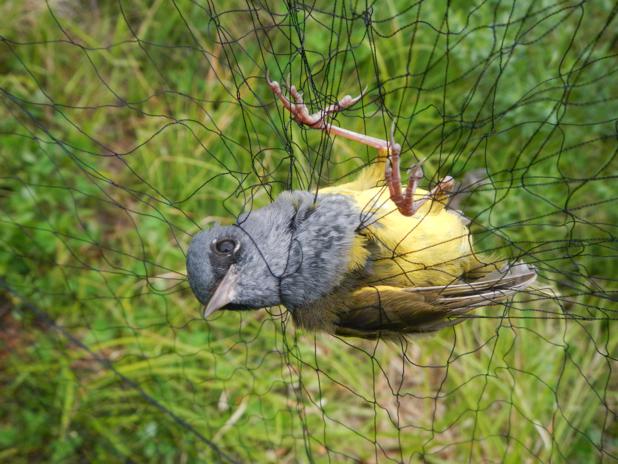
A MacGillivray's Warbler in the net. It took me less than a minute to safely extract (untangle) him.

A MacGillivray’s Warbler in the net. It took me less than a minute to safely extract (untangle) him.

There have been studies done to determine the safety of mist netting, and one study found that “Of 620,997 captures the percentage of incidents of injury amounting to 0.59% while only 0.23% of captures resulted in mortality.” They also found that birds that were recaptured more frequently were at less risk than birds only captured once. For more information, follow this link:

How Safe is Mist Netting? First Large Scale Study into Bird Capture Technique Evaluates the Risks

If you’re in the Grand Teton/Jackson WY area and would like to come out and see what we do at the banding station, join us for a Feathered Friday. There is a fee, but you get breakfast in addition to a visit with some fantastically amazing, beautiful, smart, witty, very-happy-to-be-up-at-4am- bird banders. Keegan, our crew leader, will also be there. He is just as cool as the rest of us, though maybe not quite as fantastically beautiful. (The rest of us on the crew are women, so poor Keegan has to put up with a lot sometimes).

Hope to see you around the banding station sometime, but if not some of my coming blog posts will definitely include our banding happenings, so stay tuned!

tss-logo

If you’re looking for a new blog to read, check out this one by Bo D’Amato. She’s my bunkhouse mate/roommate/fellow bander, and has a cool blog called The Eco Explorer. Check it out– there’s at least one picture of my hands holding a Wilson’s Snipe on there.

A Day In the Life of an Endangered Species Intern

I wrote this for my MatadorU travel writing course, and thought it would be fun to share here. It’s about some of the field work I was doing while I was in South Carolina last year.

When I leave the house in the morning it is dark enough to use the brights. I drive my truck along a paved road, which turns to dirt. The packed dirt is first tan, then reddish-orange, then almost white. A nightjar stares me down from the middle of the road, but as I slow it flies off into the dark.

———————————————————————————————–


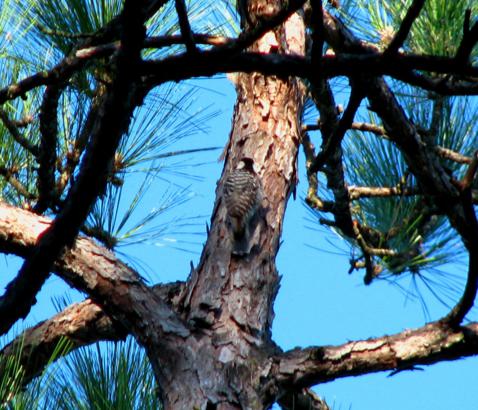
A red-cockaded woodpecker foraging in a pine. Note the black and white barring on the back, white cheek patches, and black hood. The males will have small red patches on the back of their heads, which typically can’t be seen unless the bird is riled up and raises its feathers.

———————————————————————————————–

The dark is softer when I arrive at Compartment 20, my destination. I wait in the truck, drinking tea from my thermos and listening to the radio, until the sky lightens. Just before sunrise I take one last sip and then slip into place with my spotting scope, binoculars, and notebook. I position myself about 100 yards from the nearest cavity tree and wait. The cavity I’m watching, a dark hole about 25 feet off the ground, partially hidden between branches, looks lifeless.

After ten minutes I see what I’ve come for: a red-cockaded woodpecker (RCW) bursts out into the morning, chattering loudly. It forages in a nearby tree, tapping here and there on the bark, flaking off pieces that swivel to the ground. After a few minutes another RCW joins, and the two flit from tree to tree calling and foraging, taking stock of the day.

Fully grown, an RCW is the size of a robin with black and white stripes running across its back, sometimes called a ladder back. Like clowns, they have giant white cheek patches and tiny black caps. The males have red cockades, or small red patches, on each side of their black caps.

I follow the pair for the better part of an hour before I leave them to their business. Back at the truck I take a sip of now-cold tea before reading through my notes. Both RCWs were unbanded, which means they had not been captured and fitted with aluminum USGS numbered bands or colored plastic bands, which we use to identify individual birds. Because there were just the two of them, they are most likely a potential breeding pair, or a pair of mated RCWs who for whatever reason didn’t nest this year.

I was out this morning doing an early morning nest check, observing what was going on in a particular cluster of RCW cavity trees. These checks help to determine the overall breeding status and size of the RCW population on the refuge. They also mean that I get to spend early mornings in the woods staring at trees, hoping birds will show up so I can follow them and see what they’re up to.

In 2012 I spent three months as an endangered species intern, studying RCWs with the biologists at Carolina Sandhills National Wildlife Refuge. My internship, arranged through the Student Conservation Association, provided me with the opportunity to do hands-on conservation biology and work with government biologists to study an endangered species, a bird that few have heard of, let alone seen. My background in biology, and specifically ornithology, the study of birds, has taken me around the country to different wildlife refuges and protected areas, where I’ve had the privilege to experience many different aspects of the natural world.

Carolina Sandhills is located just outside of McBee, South Carolina, which is located just outside of the middle of nowhere.  As a local intern explained to me, towns in the region are defined by whether or not they have a Wal-Mart. McBee does not have a Wal-Mart.

———————————————————————————————–


Carolina Sandhills NWR is divided into 21 compartments; each typically has 10-12 clusters of cavity trees. The maps give us an approximate idea of where the trees are, and we then find them on foot using a compass and a large dash of intuition. It sometimes took a while to find particular trees, as the maps are not entirely accurate.

———————————————————————————————–

Red-cockaded woodpeckers (Picoides borealis) have been on the endangered species list since 1970, and the current population is estimated to be about 12,500. Like many endangered species, RCWs are closely tied to their habitat, in their case the longleaf pine ecosystem. There once were about 90 million acres of longleaf habitat spreading across the eastern United States, from New Jersey south to Florida and west to Texas, Oklahoma, and Missouri. Only 2 million acres remain, in mostly isolated patches scattered through the southeast.

That much ecosystem doesn’t just disappear on its own. Logging, agriculture, the turpentine industry, tree farming, and urbanization, along with the suppression of natural fires, contributed to the decline of longleaf pine. Of these, burning is perhaps the most critical, because when fires are suppressed the composition of the forests changes. Fewer fires promote the growth of hardwoods, which the RCWs have no use for. They need pines, and pines need fire.

Natural fires, caused by lightning strikes, are typically low-intensity burns. These fires incinerate the fallen needles and grasses and leave mature trees undamaged. This keeps the area around the longleaf cleared, reducing competition and providing open areas for their seeds to quickly absorb nutrients from the ash. Longleaf pine forests are typically composed of just longleaf; there is an obvious lack of mid-story trees. The ground is covered with a high diversity of plants, all of which benefit from fire as well. Frequent forest fires “acted as the thread which held the longleaf pine forest together (1).”

RCWs are the only woodpeckers that nest in living pines. Connoisseurs, they prefer their trees aged: old-growth longleaf pine being most favored. The best longleaf will have red-heart disease, which softens the heartwood enough for the birds to easily excavate a cavity, anywhere from 10 to 80 feet off the ground. Longleaf pines have a high resin yield, and are very sticky trees. RCWs will open up sap wells all over the tree, which are especially good at keeping away rat snakes that will try to climb up and eat their eggs and nestlings. It is easy to spot cavity trees once you know what to look for—a large reddish section of bark midway up the tree, encrusted with sap.

Biologists (and interns) monitor most of the trees on the refuge with cavities, of which there are over 1,300. Thankfully, we only need to monitor the ones with recent activity, about a third of the cavity trees. The refuge is 45,348 acres, so there is a great deal of driving and hiking involved in this line of work.

Later in the morning, I drive to the office to fill out the official observation form for Nancy, the refuge biologist. Grabbing up my notebook and the spotting scope, I head inside.

“So how did it go out there?”  Nancy asks.

“I had two. They stayed mostly in Compartment 20, then headed towards that farm across the road off the refuge, then back towards Compartment 21.”

“That’s interesting; I wonder why they went over there. Ok, good. I thought I had heard birds out there during nest checks. Did they have bands?

———————————————————————————————–


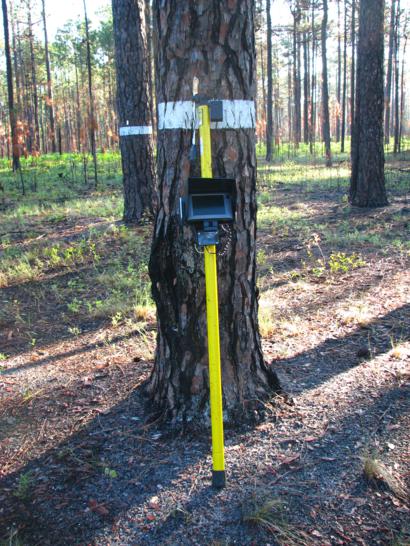
My peeper, leaning on a marked cavity tree. All known cavity trees are marked with a broad band of white paint to help not only biologists but also the firefighters who set prescribed burns on the refuge identify them. Peepers are about five feet tall and extend up to 35 feet. 

———————————————————————————————–

“Nope, both unbanded.”

“What trees were you watching?”

“I was set up on 93, and the first RCW came from the cavity near the top of the tree. The other came from behind me, probably 97.”

We talk a little more about details of my observations, and Nancy shares her morning experiences in a different compartment. I fill out the official observation form, and she gives me my instructions for the day. I have five trees to inspect, checking up on nestlings we banded about two weeks ago.

“How’s your peeper been working?” she asks. Peepers are cameras on telescoping poles, which we use to ‘peep’ into RCW cavities. They keep us from having to climb the trees so we can make our observations more quickly, which means less stress for the birds, though not always for us. RCW cavity openings are about 2 inches in diameter, and directing a camera head smaller than your fist into a 2 inch hole 30 feet or so above the ground takes a bit of skill and practice. As a rule, the sun will be in your eyes, it will be windy, and/or there will be branches in the way.

“Okay I guess, but sometimes the arm that holds the camera up doesn’t stay tight, so when I pull it out of the cavity it flops straight down, and then I have to lower the entire thing and re-adjust it if I need another look, which is a pain.”

———————————————————————————————–


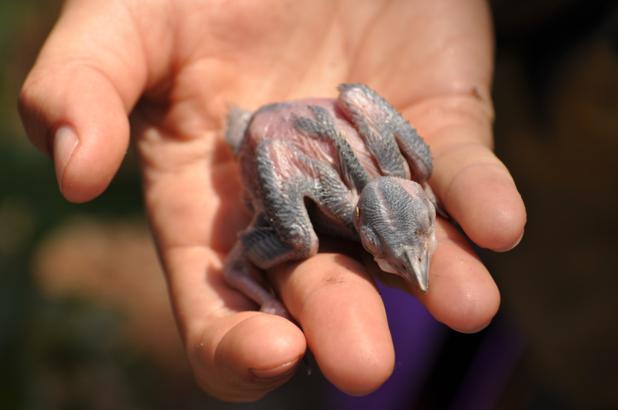
A RCW nestling, about 7 or 8 days old. Its eyes are unopened, and the feathers are just starting to come in and poke through the skin. Their feathers grow in tracts, the darkened areas on the bird’s head, back, and wings. It takes RCW’s about 20 days to become fully feathered and reach adult size.

———————————————————————————————–

Woodpecker nestlings are altricial, which means they are born without feathers, eyes closed, and are pretty much helpless. It takes about 20 days for RCW nestlings to grow in their adult feathers. Juvenile males will have the distinctive red crown patches on their temples; females’ just plain black and white. I peep into cavities and look for splotches of red, jotting down the number of nestlings and their sex: male, female, or unknown, if they are being uncooperative and sitting on top of one another so I can’t see the back of their heads.

As I drive off through the refuge towards my first cavity, I hear the chatter of brown nuthatches in the pines to my left. They sound like so many squeaky toys, jumping around in the trees like little yippy dogs. Listening closely, every once in a while I hear the “sklit, sklit” of an RCW flying overhead.

———————————————————————————————————————-


1. Auburn Forestry site: The Longleaf Alliance

Additional Information

Blog posts about my experiences: 

Bird Banding with the Teton Science Schools

So here I am in the Tetons, about to start a three month stint working for the Conservation Research Center of the Teton Science Schools (TSS). I am working with the bird banding crew, and our job is to catch birds at five different sites; three around the town of Jackson, Wyoming, and two in the Grand Teton National Park.

view of the grand_618x374

Our sites are in both developed and undeveloped areas (the ones in downtown Jackson are interesting, as we sometimes get homeless people hanging out in our net lanes). One goal of the project is to see how songbirds respond to different levels of development, by comparing our data from site in the park (which are undeveloped) and those in downtown Jackson (located in the middle of housing developments and surrounded by busy roads). There have been 21 years of banding going on through the TSS, and it’s exciting to be contributing to such long-term research.

I’m still learning about our particular project, but if you follow the link above it will take you to the CRC website, which has a nice little description of our research. I will also be sharing more as the season goes on, so stay tuned!

anya with ssha_464x618

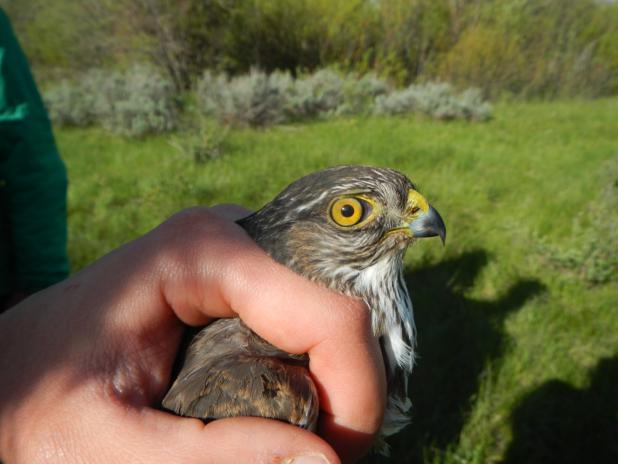
One of our volunteers, Anya, with the male sharp-shinned hawk.

We’re still in training at the moment, but official banding starts on Friday. I’m excited. Our first day is at one of our sites in the park, and Jenny, our boss, has said they typically see the most wildlife at that site, including moose, bison, bear (black and grizzly), and white-tailed deer. But don’t worry Mom, we were all issued bear spray yesterday and trained in its use. I’m hoping never to get close enough to spray down a grizzly, but it’s good to know the spray cannister works.

During our most recent practice banding session, we caught a couple of exciting birds (all birds are exciting, but these were especially so. They also might have been the only ones I remembered to take pictures of…):

First was this male Sharp-shinned Hawk

DSCN6105_618x464

And this older male Lazuli Bunting, who was absolutely gorgeous:

lazuli bunting_613x464

(links in green will take you to more information about these species)

Can’t wait to see what else we catch in our nets this summer!

Lost in the pines

Written in Yellowstone National Park, Wyoming, July 2012

Wyoming rainbow

The lodgepole pines grow incredibly dense, packed in just inches away from each other.

They make a solid, living wall of green and needles. I wonder what it would be like to slip between the trunks and lose yourself. You wouldn’t have to go very far to be lost from sight.

How far would you have to go to find yourself again?